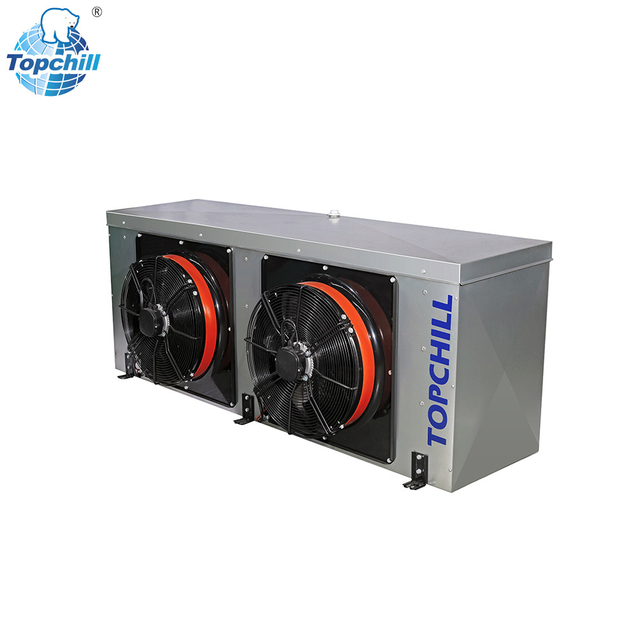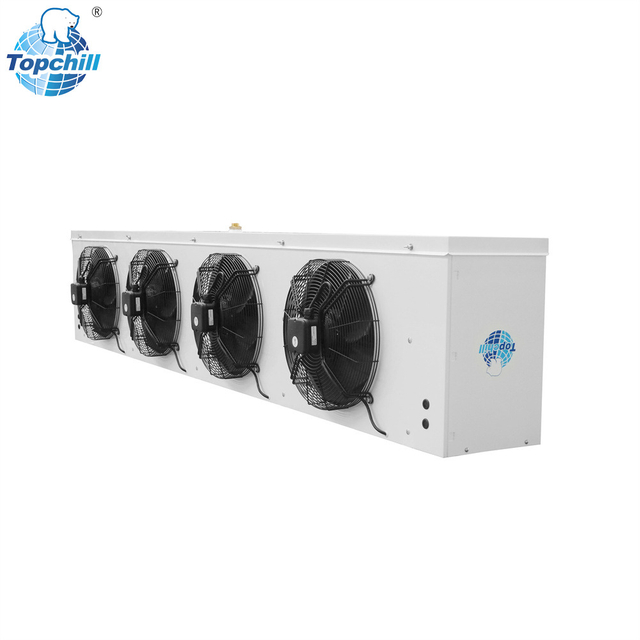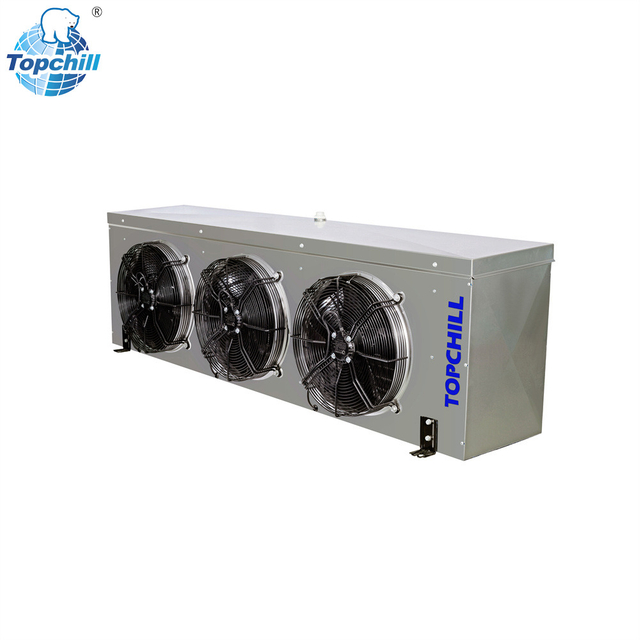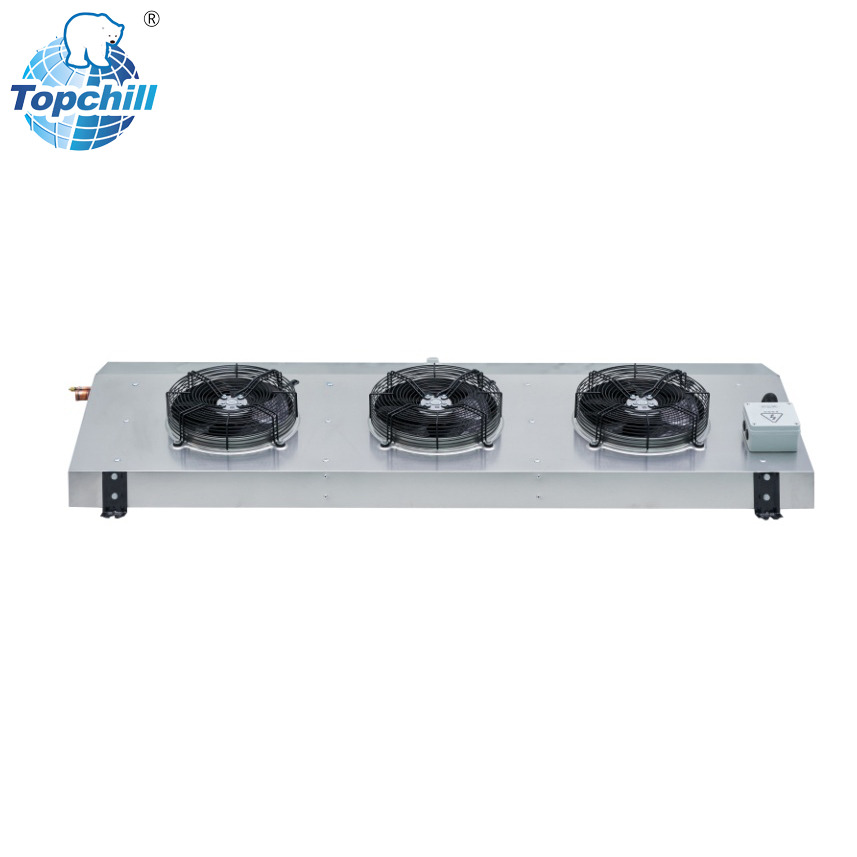


The Food-Grade Air Cooler Medium Temperature is engineered for small cold rooms where every cubic meter matters. This angled unit cooler directs air efficiently across the storage space while keeping the floor area open for shelving, crates, trolleys, or hanging product. Compared with bulkier vertical arrangements, the compact side-blow layout helps make the room feel less crowded and easier to organize, especially in narrow chambers, supermarket service areas, and small processing rooms. The result is a colder, more even environment with fewer stagnant pockets and faster pull-down of room temperature after loading.
This series uses 12.7 mm internal-threaded copper tubes matched with sine-wave aluminum fins to improve heat exchange efficiency while maintaining reliable structural contact between tube and fin. The fin spacing of 6 mm is selected for medium-temperature duty, where frost control and steady airflow both matter. In real operation, that means the coil is better suited to rooms that open regularly, store moisture-bearing products, or cycle between loading and holding conditions. The air movement is crisp and direct rather than turbulent, helping the room feel uniformly cooled without creating harsh drafts over sensitive packaged food.
The housing is built from corrosion-resistant aluminum-magnesium alloy, giving the unit a clean metallic finish and a practical balance between strength and low weight. External rotor axial fans provide reliable airflow, while the centralized junction box simplifies installation and service access. For operators, that translates into lower handling effort during installation, easier electrical connection on site, and a neater overall equipment layout. For cold room users, it means stable air temperature, lower maintenance burden, and a cooling unit that supports freshness, texture retention, and cleaner day-to-day hygiene management.
| Item | Specification |
|---|---|
| Product Name | Food-Grade Air Cooler Medium Temperature |
| Series | TAM angled unit cooler series |
| Application Type | Small-scale medium-temperature cold storage |
| Recommended Room Temperature | 0°C to -18°C |
| Series Platform | 14 standard models across the angled unit cooler family |
| Medium-Temperature Selection on This Page | 7 TAM model options |
| Cooling Capacity Range | 2 to 8 kW class |
| SC2 Capacity Range | 1.3 to 4.9 kW |
| SC3 Capacity Range | 1.9 to 7.1 kW |
| Suitable Cold Room Size | Approx. 5–50 m² |
| Fin Spacing | 6 mm |
| Tube Material | 12.7 mm internal-threaded copper tube |
| Fin Material | Sine-wave aluminum fin |
| Housing Material | Corrosion-resistant aluminum-magnesium alloy |
| Fan Type | External rotor axial fan |
| Fan Diameter | Φ300 mm |
| Fan Quantity | 1 to 3 fans |
| Fan Motor Power | 85 W per fan |
| Airflow Range | 1115 to 3780 m³/h |
| Defrost Type | Electric defrost |
| Fin Defrost Power | 0.6×2 kW to 1.7×2 kW |
| Pan Defrost Power | 0.3×1 kW to 0.8×1 kW |
| Inlet / Outlet Pipe Size | Φ12/Φ16 mm to Φ12/Φ28 mm |
| Drain Pipe | G1 |
| External Dimensions | 805×790×275 mm to 1905×790×275 mm |
| Unit Weight | 21 to 52 kg |
| Fan Protection | IP55 |
| Motor Insulation Class | F class |
| Ambient Fan Operating Range | -40°C to +40°C |
| Refrigerant Compatibility | Compatible with common refrigerants used in cold room systems |
| Temperature Control Accuracy | ±0.5°C |
| Typical Sound Level | Approx. 55 dB |
| Installation Advantage | Compact angled structure with centralized junction box |
| Model | SC2 Capacity (kW) | SC3 Capacity (kW) | Circuit Volume (dm³) | Fan Configuration | Airflow (m³/h) | Fin Defrost Power | Pan Defrost Power | Inlet / Outlet | Drain | External Dimensions (mm) | Weight (kg) |
|---|---|---|---|---|---|---|---|---|---|---|---|
| TAM1.3/301E | 1.3 | 1.9 | 1.8 | 1×Φ300, 1×85W | 1260 | 0.6×2 | 0.3×1 | Φ12/Φ16 | G1 | 805×790×275 | 21 |
| TAM1.8/301E | 1.8 | 2.4 | 2.7 | 1×Φ300, 1×85W | 1115 | 0.6×2 | 0.3×1 | Φ12/Φ16 | G1 | 805×790×275 | 22 |
| TAM2.4/302E | 2.4 | 3.2 | 2.7 | 2×Φ300, 2×85W | 2730 | 1.1×2 | 0.5×1 | Φ12/Φ16 | G1 | 1355×790×275 | 33 |
| TAM2.6/302E | 2.6 | 3.8 | 3.6 | 2×Φ300, 2×85W | 2520 | 1.1×2 | 0.5×1 | Φ12/Φ22 | G1 | 1355×790×275 | 35 |
| TAM3.4/302E | 3.4 | 4.8 | 5.4 | 2×Φ300, 2×85W | 2230 | 1.1×2 | 0.5×1 | Φ12/Φ22 | G1 | 1355×790×275 | 37 |
| TAM4.0/303E | 4.0 | 5.7 | 5.4 | 3×Φ300, 3×85W | 3780 | 1.7×2 | 0.8×1 | Φ12/Φ28 | G1 | 1905×790×275 | 49 |
| TAM4.9/303E | 4.9 | 7.1 | 8.1 | 3×Φ300, 3×85W | 3345 | 1.7×2 | 0.8×1 | Φ12/Φ28 | G1 | 1905×790×275 | 52 |
| Condition | Details |
|---|---|
| SC2 | Evap. -8°C, TD 8K, Air Inlet 0°C, SH 5.2K, RH 85% |
| SC3 | Evap. -25°C, TD 7K, Air Inlet -18°C, SH 4.6K, RH 95% |
This Food-Grade Air Cooler Medium Temperature is not simply a fan-coil assembly for a cold room. It is a carefully matched evaporator solution for operators who need stable cooling, practical installation, and room-efficient layout in one package. Its design choices reflect the real conditions of food handling spaces: repeated door openings, variable product loads, hygiene expectations, and the need to keep maintenance straightforward.
Space-saving angled layout
The side-blow structure helps free up usable floor area and improves layout flexibility for shelves, boxes, carts, and hanging products. In compact rooms, this matters as much as cooling capacity.
Medium-temperature fin design
The 6 mm fin spacing is selected for medium-temperature use, helping balance heat transfer performance with frost management in rooms operating down to -18°C.
Food-grade-friendly airflow behavior
The airflow is strong enough to move cold air through the room evenly, yet controlled enough to avoid excessive localized blasting on packed food, dough, produce crates, or prepared ingredients.
Durable coil and casing materials
Internal-threaded copper tubes, aluminum fins, and corrosion-resistant aluminum-magnesium housing support long service life in damp and frequently washed environments.
Reliable fan operation
IP55 external rotor axial fans with F-class insulation are built for dependable work under demanding ambient conditions.
Simplified installation and service
The centralized wiring arrangement and comparatively low unit weight make handling, mounting, and connection more efficient for site teams.
The common pattern across leading cold storage and air cooling products is clear: users do not buy cooling hardware only for its headline capacity. They buy it because it protects texture, extends holding time, stabilizes room conditions, and keeps workflow moving. That is exactly where this product fits. The Food-Grade Air Cooler Medium Temperature is most valuable in rooms where product quality and operator convenience must be maintained at the same time.
Small food cold rooms
Suitable for meat, seafood, frozen prepared foods, dough-based items, dairy support storage, and ingredient holding rooms where consistent medium-temperature cooling helps preserve texture, color, and handling condition.
Supermarket back-room refrigeration
A strong choice for deli reserves, bakery holding spaces, and service-area cold rooms where quiet operation and compact installation are important.
Agricultural storage support
Useful for berries, cut vegetables, processed produce, and small farm-based freezing or holding operations that need reliable air circulation without installing oversized equipment.
Food processing support zones
Works well in pre-cooling rooms, packaging support rooms, and intermediate holding spaces where temperature spikes after loading must be controlled quickly.
Laboratory and healthcare-related small storage
In projects requiring controlled cooling in limited space, the stable temperature behavior and cleanable structure are practical advantages.
In food environments, material choice changes the daily experience of cleaning, inspection, and long-term reliability. The best air coolers are not just cold; they are structurally sound, corrosion-aware, and easier to keep presentable after months of moisture exposure. This product follows that logic with a material package that supports both performance and appearance.
Copper tube and aluminum fin heat exchanger
This pairing is widely preferred because it delivers efficient heat transfer and dependable coil structure. The internal-threaded copper tube also helps improve refrigerant-side heat exchange.
Corrosion-resistant outer housing
The aluminum-magnesium casing gives the unit a firm, clean, industrial finish while resisting the dulling and surface degradation common in damp rooms.
Optional hygiene-oriented project matching
For facilities with stricter sanitation expectations, stainless-oriented project configurations can be considered where required by the operating environment.
Surface practicality for routine cleaning
The compact geometry and accessible components make it easier to wipe down surrounding areas, inspect the drain path, and maintain a cleaner visual standard in the room.
Built for long service life
The combination of corrosion-aware construction and practical defrost design supports lower maintenance stress over the lifetime of the installation.
A medium-temperature air cooler succeeds or fails in the way it moves air. In real cold rooms, uneven airflow causes edge frosting, warm pockets near doors, soft product corners, and inconsistent holding quality. This unit is designed to address those issues by combining a compact side-blow pattern with a properly matched fan platform and coil arrangement.
Uniform room coverage
The airflow range of 1115 to 3780 m³/h allows the series to cover small rooms effectively without forcing users into oversized equipment.
Better temperature consistency
Stable air movement supports narrower room temperature variation, helping reduce the risk of local hot spots after stock rotation or frequent door opening.
Fast recovery after loading
In rooms that receive baskets, trays, cartons, or short-cycle handling, the airflow helps pull the room back toward set temperature more efficiently.
Reduced frost-related performance loss
The 6 mm fin spacing is appropriate for medium-temperature service where moisture is present but a freezer-style wide-fin design is not always necessary.
Low-noise operating character
Around 55 dB, the fan sound remains suitable for back-room and near-service-area use, where loud mechanical noise can become disruptive.
The strongest equipment pages in this category do more than describe cooling. They explain how the product behaves after delivery, during installation, and across years of use. That practical angle matters because site conditions vary, electricians work under time pressure, and cold room teams need equipment that is straightforward to live with.
Compact installation footprint
The angled design helps preserve usable room space and suits small chambers where every rack position matters.
Manageable unit weight
At 21 to 52 kg, the series is easier to handle than many heavier industrial assemblies, especially in restricted installation areas.
Centralized junction box
This feature reduces on-site wiring complexity and supports a neater final installation.
Electric defrost support
Fin and pan defrost power are matched across the model range to help maintain coil performance and drain reliability in real operating conditions.
Drain and piping practicality
Standardized inlet/outlet sizing and G1 drain connection simplify integration into cold room refrigeration systems.
Service-friendly structure
For routine inspection, cleaning, and troubleshooting, the compact but organized design helps reduce downtime and maintenance frustration.
Across the most effective competitor pages, one theme appears again and again: users value products that can be matched to a room, not just sold as generic hardware. That project logic is important for air coolers because the right unit depends on room size, door frequency, product moisture load, target temperature, and refrigerant system design. This series is well suited to that application-based selection approach.
Model range for small cold rooms
The seven TAM options on this page give a practical spread from lighter-duty rooms to more demanding small storage applications.
Matched to medium-temperature duty
The product is positioned for rooms down to -18°C, where cooling must stay stable without overcomplicating the evaporator design.
Compatible with common refrigerant systems
The heat exchanger platform is built for integration with commonly used cold room refrigeration circuits.
Supports different use cases within one family
Food storage, back-room support, small processing areas, agricultural preservation, and controlled sample storage can all be addressed through model matching.
Optional material and system coordination
Depending on the project, configuration can be aligned with condensing unit selection, room size, piping layout, electrical conditions, and hygiene priorities.
Choosing an evaporator supplier is not only about today’s quotation. It is about whether the unit arrives well matched, installs without unnecessary friction, and keeps working in the background without becoming a maintenance problem. That is why buyers often prefer manufacturers who understand full refrigeration system coordination rather than supplying a coil in isolation.
Application-based model selection
We focus on matching airflow, capacity, fin spacing, and physical dimensions to the actual room, not just to a target number on paper.
Practical cold room experience
Our product range covers core refrigeration components, which helps us understand how the air cooler should work with the rest of the system.
Attention to material durability
Coil construction, casing resistance, and fan reliability are chosen with real cold room humidity and cleaning conditions in mind.
Clear technical communication
Buyers need parameters they can compare quickly. We provide structured technical data for easier selection and specification review.
Support for customized projects
Different rooms require different priorities: footprint, airflow direction, operating temperature, corrosion resistance, and maintenance accessibility.
Long-term value focus
The goal is not only initial cooling performance, but also stable operation, manageable upkeep, and dependable room conditions over time.
Instruction manual
Air coolers
I. Overview
Air cooler (also called chiller) is a kind of cooling equipment suitable for various cold storage, Chengdu Tianqi air cooler has three types of 4.5-pitch, 6-pitch and 9-pitch, which are respectively suitable for cold storage of different storage temperature. It has the advantages of compact structure, light weight, not occupying the practical area of the cold storage, etc. Compared with the natural convection exhaust pipe, it can make the food stored in the cold storage cool down quickly, and greatly improve the freshness of the stored food.
II. Product use
Chengdu Tianqi air cooler can be used as refrigeration equipment with different refrigeration capacity of compression condensing unit for cold storage of different temperature. The 4.5-pitch air cooler is suitable for the cold storage with the temperature of 0℃, such as the storage of fresh eggs or fruits and vegetables, and the 6-pitch air cooler is suitable for the cold storage with the temperature of -18℃ as the cold storage of meat, fish and other frozen foods, and the 9-pitch air cooler is suitable for the cold storage with the temperature of -25℃ or below-25℃ as the freezing of fresh meat or fresh fish products and seasoned foods.
Ⅲ. Product features
1、The shell is made of plastic spraying steel plate, rolled aluminum plate or stainless steel plate, which is corrosion-resistant and beautiful in appearance, and can meet the needs of different customers.
2、The coils are arranged in the way of rows or fork rows, which can be selected according to different usage environments, and the heat transfer efficiency is high.
Aluminum fins are set on copper or aluminum tubes and connected firmly.
3、The product is wired in the factory, and all the fan wiring is placed in a junction box, which is convenient for installation and maintenance.
4、The motor and wind blade are selected for low noise, smooth operation and explosion-proof motor according to users' needs.
5、Drainage pipe is equipped with drainage interface at the lowest place in the center, reliable drainage.
6、Tubular stainless steel tube and magnesium oxide filler electric heating tube, placed in the coil, the effect of frost melting is good, several optional frost melting method (electric heating tube, water, hot air).
7、All of them have been processed with nitrogen before leaving the factory.
IV. Precautions
1. Please read the precautions in the document carefully before use.
2. Personal protective equipment should be equipped when operating this equipment, such as: gloves, glasses, protection.
3. Avoid touching the edges of the sheet metal and the fins of the coiler, the sharp edges may cause injuries.
4. All on-site wiring must comply with industry code standards and national and local codes. For any maintenance service or point up operation must first cut off the power supply, is strictly prohibited to operate with electricity.
5. Before starting the machine, the professional and technical personnel should verify whether the electrical parameters of the equipment match with the actual use of the power grid.
6. Should confirm that the equipment circuit and refrigeration system electrical protection device is normal and intact before the equipment can run. Equipment should be installed reliable grounding protection.
7. In the daily maintenance and repair work, wear eye protection and gloves, and be very careful handling of refrigerant, to avoid inhalation and contact with refrigerant, otherwise it may lead to blindness or other injuries or even death.
8. When installing and operating the equipment, it should be far away from high temperature open fire and corrosive substances, and there should be no combustible and explosive materials around the equipment to prevent fire and other accidents.
9. Correctly adjust the direction of air outlet of the chiller.
10. The chiller has been filled with high-pressure nitrogen when it is shipped from the factory, and can only be installed and used when the nitrogen is emptied.
11. The daily maintenance and repair work must be carried out by the corresponding professional technicians, in addition to cleaning, should focus on the electrical heating
In addition to cleaning, should focus on the electric heating tube, fan and other electrical reliability, safety, regular inspection and testing and record, found abnormalities should be promptly excluded afterOnly then can it be operated.
WARNING
1. It is strictly prohibited to insert any object into the fan during operation to avoid injury to personnel and damage to equipment.
2. In order to ensure the safety of the user and the correct use of the product, it must be operated by a professional (refrigeration serviceman/electrician),
Installation and maintenance. The operation must be equipped with personal protective equipment, otherwise the company does not provide quality assurance, and does not assume any legal responsibility for the resulting accidents.
Otherwise, the company does not provide quality assurance and does not bear any legal responsibility for the accidents caused.
3. When the chiller adopts electric heat to tolerate frost device, it must be installed with overheat protection device for frost melting temperature before use to ensure the safety of use.
4. Avoid direct contact between the skin and the operating equipment (refrigerant or piping); avoid possible frostbite or scalding.
5. equipped with electric heat defrosting device of the chiller, 18 months from the factory date, the customer should be regularly on the use of the performance of the electric heat pipe and the safety performance, insulation performance test, found abnormalities immediately replace the maintenance before use. Otherwise, the company will not assume any legal responsibility for the adverse consequences caused by this.
6. When the heating tube exceeds the normal service life, it should be replaced in time in order to eliminate potential safety hazards.
7. It is strictly prohibited to use oxygen to keep pressure on the chiller. 8.
8. There should be no bare insulation material within 2.0 meters around the chiller, and it must be veneered with metal material. Avoid electrical sparks generated by electric heaters, terminal aging, etc. and ignite the insulation materials in the warehouse.
9. Conventional chillers are strictly prohibited to be used in an environment with flammable and explosive materials. (Except for special design)
V. Installation of the chiller
1. When unpacking, check that the equipment and packing materials are not damaged; any damage may affect the operating results. If you find any obvious damaged parts, please contact our company.
2. For chiller installation, please refer to the installation dimension drawing.
3. Users should use suitable equipment to lift the product to the appropriate position according to the weight of the purchased item.
4. Freon ceiling type chiller can be lifted on the roof plate of the warehouse with 4, 6, 8 or 10 long bolts. A single steel M8 bolt and nut can withstand a weight of up to 110kg and M10 can withstand a weight of up to 270kg.
5. The distance between the ceiling-mounted chiller and the wall should be maintained at 250~350mm (see the right figure), so as to facilitate the circulation flow of cold air in the cold storage and maintenance.
6. After installation, the ceiling-type chiller should be guaranteed to be level.
7. The drain pipe of the chiller should have a certain slope to the outside of the cold storage, so that the frost water can be smoothly discharged out of the library, and the connecting pipe outside the library should be curved into a U-shape, and the pipe should ensure a certain degree of liquid sealing in order to prevent a large amount of hot air outside the library from entering into the cold storage (see the figure).
8. In the cold storage of the drain outside should be insulated, the library temperature is lower than -20 ° C, the drain pipe should be added to the electric heaters to prevent frost water in the process of water leakage icing.
9, in order to achieve the best refrigeration effect, the thermal expansion valve should be installed as close as possible to the liquid separator position.
10. When installing the expansion valve, the temperature sensing package must be tightly tied in the upper part of the horizontal return pipe (suction pipe diameter ≤ 25) or the lower part of the 45 ° diagonal down (suction pipe diameter ≥ 25), and to ensure that the contact with the return pipe is good, outside the return pipe should be insulated to prevent the temperature sensing package affected by the temperature of the library.
11. The external balance pipe is used to connect the external balance port of the thermal expansion valve and the top of the horizontal suction pipe near the suction manifold. Connected to the suction pipe of 1/4 inch copper pipe is said to be the external balance pipe.
12. The chiller outlet should avoid the beam-type column so as not to affect the range of the air supply.
13. In order to ensure that the chiller achieves optimum heat transfer, the distributor must be mounted vertically to ensure that the refrigerant is evenly distributed to the various refrigeration circuits.
14. The design and installation of the refrigeration pipeline must be designed and installed by professional refrigeration technicians in accordance with national and local norms, and at the same time conform to the good refrigeration engineering operation.
15. The cleanliness of the chillers provided by our company is in line with the requirements, and the interior is pre-filled with dry nitrogen to prevent oxidation and the entry of moisture and external impurities. When installing, try to shorten the time that the receiver is exposed to the air to prevent the entry of external impurities and moisture.
16. The refrigeration connection piping does not have to be the same as the outlet piping of the chiller, and the selection and calculation of the piping size should be based on the principle of minimum pressure drop and flow rate attenuation.
17. Horizontal suction pipes need to leave the chiller at a certain inclination to ensure that the refrigerant oil is returned to the compressor by gravity. an inclination of 1:100 is sufficient. When the suction pipe is higher than the chiller, it is advisable to install an oil return bend.
18. When removing the chiller from its original installation position, it must be dismantled by a professional refrigeration technician, who should first cut off the power supply, remove all the unwanted field wiring, the corresponding electrical components, and then cut off the ground wire; cut off and seal the joints of the liquid pipe and the gas pipe, disconnect the drain pipe, and remove the chiller. Be sure to follow the above procedure when operating. Failure to follow this procedure will result in injury or death to the operator and property damage due to fire or explosion. Venting refrigerant directly into the atmosphere is illegal and can result in severe fines from the monitoring authority.
19. In order to equalize the pressure between the evaporator and the outside world, special care must be taken when opening the needle valve spool. A certain amount of refrigerant is dissolved in the lubricating oil and when the pressure of the chiller rises the refrigerant boils and evaporates, which may result in injury.
20. If the equipment is not to be used for a longer period of time, pump the entire charge of refrigerant back into the reservoir or into a suitable reservoir (refrigerant cylinder).


VI. Electrical connection of the chiller
1. All electrical connections must follow the appropriate specifications and be implemented by a professional electrical technician.
2. Electrical connection diagram
Ⅶ. Chiller commissioning guidelines
1. The start-up commissioning of the refrigeration system needs to be in line with the correct refrigeration operation reality and should be operated by a certified refrigeration mechanic.
2. Due to transportation may lead to loose factory wiring, please reconfirm the factory wiring and the wiring on site. Check whether the running direction of the fan motor is correct, and whether the airflow is drawn in from the coil and discharged from the fan side.
3. Check whether the thermostat of the storage room is running normally, and adjust the parameters if necessary.
VIII. Defrosting guide for chillers
In order to enable customers to get the most efficient and maximum airflow when using our evaporators, it is recommended to defrost according to the following defrost parameters.
Saturated suction temperature | -30 | -24 | -18 | -12 |
Number of defrosts at maximum temperature difference | 7 | 7 | 6 | 6 |
Number of defrosts for temperature differences | 5 | 4 | 4 | 4 |
Number of defrosts withe minimum temperature difference | 4 | 3 | 3 | 4 |
The recommended defrost time (-18°C cold storage) is adjusted according to actual usage.
Difference in temperature | Light duty | Heavy duty | Light duty | |||||
1 | 2 | 3 | 4 | 5 | 6 | 7 | 8 | |
10 | × | × | × | × | × | × | × | |
8 | × | × | × | × | × | × | ||
6 | × | × | × | × | ||||
4 | × | × | × | |||||
Note: Each column represents 3 hours of the daily time period. The “x” shows when defrost should start. “Heavy Duty” shows the ‘work phase’ of the day in the usual sense.
Defrost Termination Requirements
The average defrost time for a normally loaded system is approximately 20-25 minutes (including drip time). This defrost time can vary with the degree of frost buildup.
Time Out - The time out is set to ensure that the coil is defrosted even under the heaviest loads. Typical time settings are 25-30 minutes with a safety shut-off time of 35 minutes.
Temperature termination - The temperature termination is set depending on the frequency of defrosting and the condition of the frost, but also on the position of the temperature sensor/temperature switch. If an electronic defrost controller is used, the set point for temperature termination must be determined individually for each chiller in the installation environment. The set point is generally around 15°C for the chiller outlet air duct for example.
Electric heating tube overheating protection - The standard products of the chiller produced by our company do not come with heating tube overheating protection device. The customer is responsible for installing a suitable protection device to prevent damage to the chiller and fire and other accidents caused by excessive temperature and pressure in case of controller and sensor failure.
Fan Delay Requirements - Fan delays will vary depending on the application, but in general should not exceed 5 minutes.
IX. Routine maintenance of equipment
Depending on the normal operating conditions and bad conditions, after successful commissioning, a maintenance schedule should be prepared to ensure that the chiller operates at optimum efficiency while keeping operating costs to a minimum. When doing maintenance, check and record the following parameters:
1)Check the chiller for corrosion, abnormal vibration, oil plugging and dirty and clogged drain pipes, which need to be cleaned frequently with soapy water.
2)Clean the fins of the chiller with a soft brush, rinse the coil with low pressure water or use special coil cleaner. Acidic cleaners are prohibited. Follow the labeled instructions for use. Rinse the coil until there is no residue.
3)Check each motor fan for proper rotation, fan cover for blockage, and loose bolts.
4)Check wires, terminals and other components for damage, loose wiring, and blackened components with burn marks.
5)Check whether all the coil heating tubes are in the original position, whether they are firmly installed, check whether the heating tubes of the water accumulation coil are in good contact with the tray and whether the position is on the bracket.
6)Check whether the frost on the coil on the exhaust side is even during operation. Uneven frosting indicates that there is a blockage in the dispensing head or the refrigerant is not charged correctly. Possible superheated gas on the coil at the suction side without any frosting.
7)Adjust the defrost cycle according to the abnormal frost condition.
8)Check the superheat level and adjust the human expansion valve accordingly.
9)The power must be disconnected during cleaning and maintenance (electrified operation is strictly prohibited), and the water accumulation disk is also a component that needs to be repaired, and there is a hidden danger if the chiller is operated without installing the water accumulation disk.