Views: 0 Author: Site Editor Publish Time: 2026-07-05 Origin: Site


Industrial deep-freeze and cold storage facilities operate under unforgiving conditions. When you manage spaces running between -20°F and -50°F, standard commercial refrigeration equipment simply will not survive. The thermal loads are too extreme. If your system fails or loses efficiency, you face immediate, catastrophic product loss and massive energy waste. You need heavy-duty, continuous-duty solutions built for these specific environments. The Low-Temperature Screw Condensing Unit serves as the backbone for high-capacity, low-temp applications. Specifying the right equipment demands a hard look at compressor architecture, oil management, and refrigerant compatibility. You cannot afford to guess. We will break down exactly how to evaluate and select the right unit for your facility, ensuring you get the performance and reliability your operation demands.
Specific temperature ranges and capacities classify a system as a low temperature refrigeration unit. These systems typically maintain internal environments between -20°F and -50°F. Success criteria depend on holding stable temperatures consistently across massive square footages. Blast freezers require rapid heat removal capabilities to drop product temperatures in hours, not days. Large walk-in cold rooms need uniform air distribution to prevent warm spots near doors or ceilings. The equipment must operate continuously without experiencing thermal fatigue. When you push a compressor to a -40°F suction temperature, the compression ratio skyrockets. Standard compressors overheat and fail under these conditions. Screw compressors handle this by injecting oil directly into the compression chamber, which seals the rotors and absorbs the massive heat of compression.
The type of product stored dictates specific temperature profiles. Different commodities require unique pull-down times and humidity control. You must match the equipment to the product.
Screw compressors dominate high-capacity, low-temp applications. They feature fewer moving parts than reciprocating models. This design allows for continuous compression cycles without the pulsation associated with pistons. They handle high pressure ratios without generating excessive discharge temperatures. Reciprocating compressors often burn up their discharge valves when pushed to deep-freeze temperatures. Scroll compressors work well for smaller commercial loads but lack the volumetric capacity for large industrial warehouses.
| Compressor Type | Compression Ratio Tolerance | Capacity Control | Low-Temp Suitability | Maintenance Profile |
|---|---|---|---|---|
| Screw | Excellent (Handles high ratios via oil injection) | Infinite via Slide Valve or VFD | Ideal for industrial deep-freeze | Requires strict oil analysis and vibration monitoring |
| Reciprocating | Poor to Fair (Prone to high discharge temps) | Stepped via cylinder unloading | Limited to smaller or medium loads | Frequent valve plate and piston ring replacement |
| Scroll | Fair (Requires liquid injection for low temp) | Limited (Digital scroll or VFD) | Good for light commercial, not industrial | Replace upon failure (non-serviceable) |
The condensing unit functions as the core of the refrigeration cycle. It integrates the compressor, condenser coils, and control systems into one package. This central hub maps critical relationships across the facility. It communicates constantly with evaporator coils suspended in the cold room. It also regulates electronic expansion valves (EEVs) to maintain precise superheat. Proper integration ensures optimal refrigerant flow and system efficiency. If the condensing unit does not track the suction pressure accurately, the evaporators will starve or flood. Flooding sends liquid refrigerant back down the suction line, which can destroy the compressor upon impact.
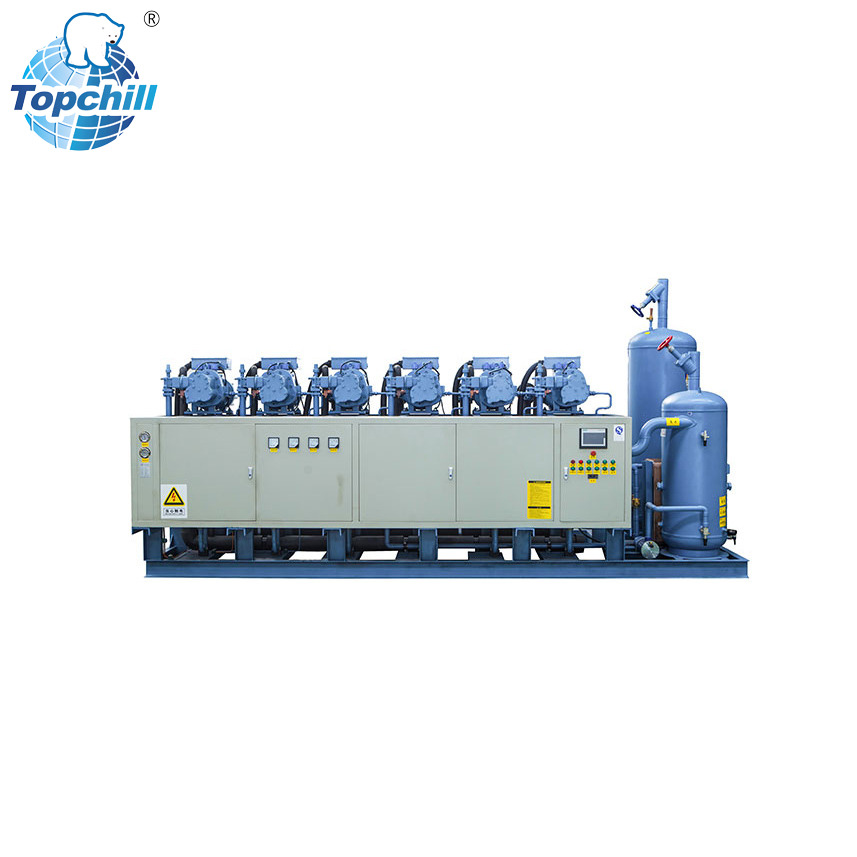
Accurate load sizing determines system success. You cannot guess the capacity. You must calculate the total heat rejection required. Several factors impact the total refrigeration load.
Oversizing creates severe operational dangers. It causes short cycling, which prevents the compressor from running long enough to return oil from the system. Undersizing leads to a complete failure to hold temperature during peak summer months or heavy production days.
Engineers must choose between two primary compressor architectures. Each offers distinct mechanical advantages in the field.
A single screw compressor unit features one main cylindrical rotor flanked by two star wheels. This design balances the radial forces acting on the main shaft. Because the forces cancel each other out, the main bearings experience significantly less load. This promotes longer bearing life and reduces overall vibration. Technicians often prefer the maintenance profile of single screw designs because they run smoother and quieter in heavy industrial settings.
Twin screw designs utilize two meshing rotors—a male and a female. One rotor drives the other, or timing gears keep them synchronized. This architecture creates heavy thrust loads, requiring massive, high-capacity bearings. However, twin screws boast high market prevalence and extreme ruggedness. They utilize mechanical slide valves for precise capacity control, allowing the compressor to match fluctuating facility loads effectively.
Units must comply with modern energy mandates. The Department of Energy (DOE) enforces strict regulations on refrigeration equipment. Annual Walk-in Energy Factor (AWEF) ratings apply to WICF applications. Selecting compliant equipment avoids regulatory penalties and ensures you install a system optimized for lower power consumption. You must verify that the manufacturer provides certified AWEF data for the specific condensing unit and evaporator combination you plan to install.
Evaluate the unit's compatibility with modern refrigerants. The industry is rapidly phasing out high-GWP HFCs like R-404A and R-507A. Facilities are shifting toward natural refrigerants and low-GWP synthetics. Ammonia (R-717) offers excellent thermodynamic properties but requires strict safety protocols and steel piping. CO2 (R-744) operates at extreme pressures, requiring specialized transcritical or subcritical system designs. A2L synthetics provide a viable, mildly flammable alternative that mimics legacy HFC performance. The chosen unit must feature the correct seals, oil types, and pressure ratings to handle these specific refrigerants safely.
Oil management represents the most critical failure point in low-temp applications. Low-temp environments demand flawless lubrication. In a screw compressor, oil cools the compression process, seals the gaps between the rotors, and lubricates the bearings. But at -40°F suction temperatures, oil becomes thick and sluggish. If it travels out to the evaporator, it coats the internal tubes, killing heat transfer and starving the compressor of lubrication.
A reliable freezer condensing unit requires a multi-stage oil separation system. High-efficiency coalescing oil separators strip the lubricant from the discharge gas before it reaches the condenser. You also need dedicated oil coolers. Because the compression ratio is so high, the discharge gas gets incredibly hot. If you do not cool the oil before injecting it back into the compressor, the oil will break down thermally, lose its viscosity, and destroy the bearings. Oil coolers can be thermosyphon, liquid injection, or air-cooled, depending on the site requirements.
Physical build quality determines equipment longevity. You are placing this equipment on a roof or a concrete pad exposed to the elements. Heavy-gauge welded steel frames reduce damaging vibrations that cause copper lines to fracture. Floating tube condenser coils prevent refrigerant leaks. In a floating tube design, the copper tubes do not touch the steel endplates directly. This allows the tubes to expand and contract with temperature changes without rubbing against the steel and creating a leak. Robust construction withstands harsh industrial environments and high wind loads.
Heat exchanger coils require specific design parameters. Fin spacing configurations must mitigate rapid frost accumulation. Tight fins block airflow quickly in freezing environments. If you use a coil with 10 fins per inch in a freezer, it will turn into a solid block of ice within hours. You need wider spacing, typically 3 to 4 fins per inch, to allow longer run times between defrost cycles. The unit must integrate seamlessly with the facility's defrost strategy, whether you use hot gas, electric resistance, or water defrost.
Economizer circuits increase the overall refrigeration effect and boost system capacity. A screw condensing unit operating at high pressure ratios needs subcooling. An economizer takes a small portion of high-pressure liquid refrigerant, drops its pressure through an expansion valve, and uses it to subcool the main liquid line feeding the evaporators. The resulting flash gas is injected into a mid-stage port on the screw compressor. This process significantly reduces compressor discharge temperatures and increases the cooling capacity by 20% to 30% without requiring a larger compressor motor.
Industrial condensing units require significant physical space. You must evaluate the footprint early in the design phase. Packaged units mounted on structural steel skids distribute the heavy weight of the screw compressors and oil separators. If you mount the unit on a roof, you must verify the structural load capacity with an engineer. You also need to account for ambient temperature extremes. Units installed in desert climates require oversized condenser coils and sun shields to prevent high head pressure trips. Units in cold climates require winterization kits, including heated control panels, variable speed condenser fans, and insulated liquid receivers to maintain proper head pressure during winter operation.
Assess the long-term serviceability of the unit. Screw compressors run for tens of thousands of hours if maintained correctly. Standard maintenance routines include regular vibration analysis to detect bearing wear before a catastrophic failure occurs. You must perform quarterly oil sampling to check for acid, moisture, and metal shavings. Filter replacements on the oil lines and suction lines are mandatory. Select a manufacturer with a robust domestic parts supply chain. If a coalescing filter or a slide valve actuator fails, you cannot wait six weeks for a part to ship from overseas while your product thaws.
Operating screw compressors at extended low loads introduces severe mechanical risk. When a screw compressor runs at 20% capacity for long periods, it decreases efficiency and causes poor oil return. The refrigerant velocity drops too low to carry the oil back up the suction riser. Facilities must mitigate this operational hazard. Recommend proper staging of multiple smaller units rather than relying on one massive compressor. Advanced Variable Frequency Drive (VFD) integration also solves this issue. VFDs slow the compressor motor down to match the actual load, maintaining efficiency and keeping refrigerant velocities high enough for proper oil return.
The condensing unit must manage load spikes carefully. Evaporator defrost cycles create sudden pressure changes in the system. Hot gas defrost is the most efficient method for industrial freezers, but it sends massive amounts of condensed liquid refrigerant back toward the compressor. The unit must handle these shifts without liquid slugging the compressor. Proper suction accumulator sizing is critical. The accumulator catches the liquid refrigerant and boils it off slowly, ensuring only vapor enters the compressor suction port. Failure to size the accumulator correctly will result in blown rotors and destroyed bearings.
Standalone units risk failing to communicate properly with the rest of the building. They must integrate with central facility management systems. Specify units featuring open-protocol controllers. Modbus and BACnet ensure seamless data exchange between the condensing unit, the evaporator controllers, and the main plant room. This integration allows for remote monitoring, alarm logging, and predictive maintenance. You can track suction pressures, discharge temperatures, and oil pressure differentials from a central dashboard, allowing operators to catch anomalies before they cause a shutdown.
Manufacturer sizing software models performance accurately and eliminates guesswork. Programs provided by compressor manufacturers allow engineers to input specific ambient design dry bulb temperatures. You enter exact suction superheat and liquid subcooling values. You define the precise load conditions, including part-load scenarios, before finalizing procurement. This step verifies the equipment will perform as specified under your exact site conditions. It also generates the required electrical data, including Minimum Circuit Ampacity (MCA) and Maximum Overcurrent Protection (MOP), which your electrical contractors need to size the feeds.
A low-temperature screw condensing unit represents a highly reliable, heavy-duty investment. It remains absolutely necessary for industrial-scale freezing operations where standard commercial gear fails. These applications cannot tolerate unexpected downtime or temperature fluctuations. Proper selection ensures product safety, system longevity, and stable energy consumption.
Follow a strict shortlisting logic for procurement. First, audit peak and part-load requirements based on space volume and product heat loads. Second, select a refrigerant based on compliance and facility safety protocols. Third, choose between single and twin compressor architectures based on your maintenance capabilities. Fourth, specify robust oil and thermal management components to protect the compressor. Finally, verify all performance metrics via manufacturer selection software.
Take these actionable next steps:
A: These units typically operate between -20°F and -50°F. Applications requiring these extreme temperatures include blast freezers, pharmaceutical storage, plasma freezing, and large-scale frozen food distribution centers.
A: A single screw uses one main rotor and two star wheels, which balances radial forces and extends bearing life. Twin-screw designs use two meshing rotors, creating higher thrust loads but offering extreme ruggedness and precise capacity control via slide valves.
A: Deep freezing creates massive pressure ratios, leading to elevated discharge temperatures. A dedicated oil cooler prevents the compressor oil from breaking down thermally, ensuring proper lubrication, sealing the rotors, and preventing catastrophic bearing failure.
A: Capacity calculations require measuring the room volume, calculating the product ingress heat load, factoring in ambient temperature extremes, determining insulation transmission values, and adding internal heat gains from fans and defrost heaters.
A: The Annual Walk-in Energy Factor (AWEF) is a Department of Energy efficiency metric. It strictly applies to walk-in coolers and freezers, mandating baseline efficiency standards for condensing units used in these specific applications.
A: Yes, they operate efficiently at partial loads if properly equipped. Utilizing mechanical slide valves or integrating Variable Frequency Drives (VFDs) allows the compressor to slow down and match fluctuating facility loads without short cycling.
A: The industry is moving away from high-GWP HFCs like R-404A. Modern units utilize natural refrigerants like Ammonia (R-717) and CO2 (R-744), or low-GWP A2L synthetic blends designed to meet strict environmental regulations.


