Views: 0 Author: Site Editor Publish Time: 2026-09-11 Origin: Site


Poor airflow distribution in cold storage creates warm spots and accelerates frost accumulation. It forces equipment to run longer and directly threatens product integrity. Facility managers often focus entirely on raw cooling capacity. They under-evaluate how air actually moves through the space. An improperly specified airflow pattern leads to short-cycling and dead zones. It compromises the Coefficient of Performance (COP) and causes erratic load stability.
Selecting the right configuration requires matching room geometry and racking layouts to specific equipment designs. You must align thermal loads with the correct mechanical hardware. This guide breaks down how to evaluate airflow patterns accurately. You will learn to size equipment for optimal air turns. We will show you how to select a unit that ensures long-term load stability and efficient operation.
Air Turns Dictate Stability: Effective cold storage requires baseline air turns (typically 20+ per hour) distributed evenly across the entire product load, not just high velocity at the discharge point.
Geometry Drives Selection: Longitudinal airflow works best for deep rooms, while center-mounted dual-discharge patterns resolve uneven cooling in wide, low-clearance spaces.
Throw Distance is Non-Negotiable: Rooms longer than 30 feet generally require multi-fan configurations capable of maintaining specific CFM and static pressure thresholds to prevent dead zones.
Obstructions Alter Performance: Racking orientation and product stacking density will fundamentally change an evaporator’s effective airflow pattern, requiring proactive mitigation during the design phase.
Coil Design Shapes Airflow: The physical design of the coil, including fin spacing, directly dictates how the cold room breathes, frosts, and stabilizes under heavy product loads.
Establish baseline requirements before selecting equipment. Temperature uniformity across the entire storage footprint dictates system success. You need acceptable temperature deltas between supply and return air. Humidity control prevents product degradation and excessive frost. Overall load stability ensures your compressors do not overwork. A successful installation maintains strict temperature tolerances regardless of external ambient conditions. You must measure these metrics at the furthest corners of the room. Do not rely solely on readings near the discharge fans. Field technicians often find a 5-degree variance just twenty feet down an aisle when airflow fails to penetrate the racks.
Effective cold storage relies on consistent air turns per hour. Industry standards typically demand 20 to 30 air turns hourly for standard storage. You calculate this by dividing the total room volume by the cubic feet per minute (CFM) output of your fans, then multiplying by 60. Volume alone falls short. You must pair CFM with adequate velocity. High velocity penetrates dense product loads effectively. Excessive velocity causes freezer burn on sensitive goods like leafy greens or fresh meat. You must balance airflow volume with the physical resistance created by your pallets. Proper distribution ensures every pallet receives adequate cooling without dead zones.
Storage Application | Recommended Air Turns (Per Hour) | Velocity Profile | Primary Airflow Goal |
|---|---|---|---|
Packaged Frozen Goods | 20 - 25 | High | Deep penetration through dense pallets. |
Fresh Produce / Florals | 30 - 40 | Low to Medium | High humidity maintenance, prevent moisture stripping. |
Meat Processing / Prep | 15 - 20 | Low (Draft-Free) | Personnel comfort, stable ambient temperatures. |
Blast Freezing | 60 - 100+ | Extreme | Rapid heat removal, break thermal boundaries. |
Efficient mass flow rate directly impacts system performance. Return air temperatures dictate how hard your compressor works. A well-placed Evaporator captures warm return air efficiently. This optimizes the enthalpy exchange across the cooling coil. Better heat exchange improves the compressor's Coefficient of Performance (COP). A higher COP means lower energy consumption for the same cooling output. Poor airflow forces the system to run longer cycles. This draws more power and increases mechanical wear on the entire refrigeration circuit. When return air bypasses the product and short-cycles back to the fans, the compressor runs continuously while the room remains warm.
Poor return airflow patterns create localized humidity spikes. Moisture pools in stagnant areas and eventually migrates to the coil. Improper coil fin spacing exacerbates this issue. Tight fins trap moisture quickly. This leads to rapid coil frosting and restricted airflow. Heavy frost forces the system into frequent defrost cycles. Defrosting drains energy and introduces unwanted heat into the room. You must select fin spacing that matches your humidity load. Proper airflow sweeps moisture away evenly. This prevents rapid ice bridging and maintains consistent cooling efficiency.
Measure humidity levels at the return air intake during peak load times to establish a baseline.
Inspect the coil face for uneven frost patterns, which indicate blocked airflow on one side of the unit.
Adjust defrost termination thermostats to end cycles based on actual coil temperature rather than arbitrary time limits.
Clear any physical obstructions within three feet of the fan discharge to prevent air bounce-back.
This pattern positions the unit at one end of the room. Fans blow cold air straight down the length of the space. It works best for deep, narrow rooms with parallel racking. The air travels down the aisles and returns along the ceiling or floor. You must evaluate the required throw distance carefully. This setup requires high-throw fans to reach the opposite wall. If the room exceeds the unit's maximum throw distance, severe temperature gradients form. The far end remains warm while the near end freezes. Engineers often specify secondary booster fans for rooms exceeding 50 feet in length to maintain velocity.
Dual-discharge units pull warm air from the center of the room. They discharge cold air in two opposite directions simultaneously. This pattern fits wide rooms and prep areas perfectly. It works exceptionally well in spaces with low ceilings. Dual-discharge minimizes harsh drafts on personnel working below. It cuts the required throw distance in half compared to longitudinal setups. This provides highly stable air distribution across wide footprints. It prevents short-cycling by keeping supply and return air streams physically separated. Meat processing rooms and floral coolers rely heavily on this configuration to protect workers and delicate products.
Under-throw patterns direct air downward or along the perimeter walls. This creates a circular convection loop around the product. It handles high-density bulk storage effectively. This pattern works when top-level airflow faces blockage from tall pallets. It requires strict adherence to floor clearance rules. You must maintain adequate pallet spacing for the air to circulate. If pallets sit directly on the floor, the convection loop breaks. This leads to immediate dead zones and spoiled bulk products. Facility managers must paint clearance lines on the floor to keep forklift operators from pushing pallets against the walls.
Airflow Pattern | Mechanism | Best Use Case | Primary Risk |
|---|---|---|---|
Longitudinal | Blows air end-to-end down the room length. | Deep, narrow rooms; parallel racking. | Temperature gradients if throw distance is insufficient. |
Dual-Discharge | Pulls from center, blows in two opposite directions. | Wide rooms, low ceilings, prep areas. | Requires clear ceiling space; vulnerable to high-stacked pallets. |
Under-Throw | Directs air downward to create a perimeter loop. | High-density bulk storage. | Fails completely without strict floor and wall clearances. |
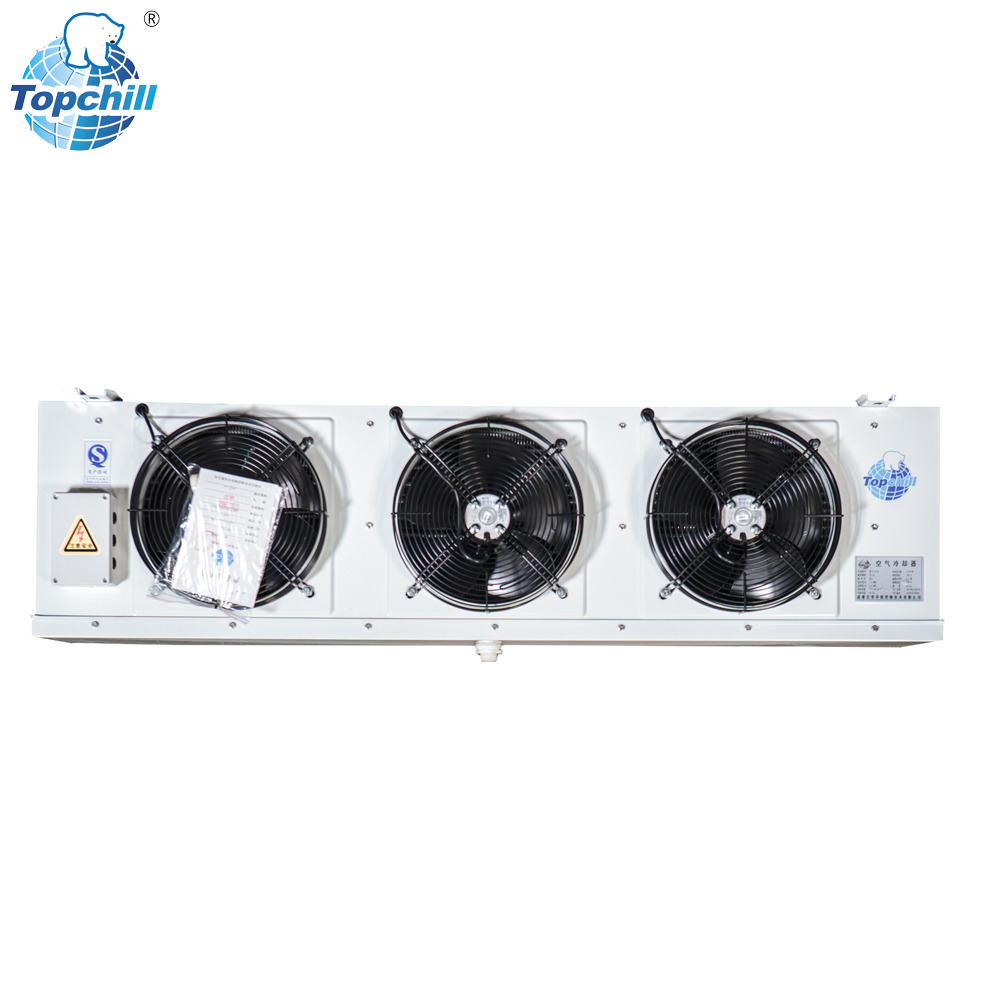
The ceiling mounted unit cooler remains the industry standard for commercial walk-ins. It handles medium-scale storage efficiently. You must assess the fan configurations carefully. Decide between draw-through and blow-through designs based on your layout. Draw-through fans pull air across the coil, offering better distribution. Blow-through fans push air, which increases velocity but reduces spread. Evaluate the ease of maintenance access. Ensure the unit aligns perfectly with your intended longitudinal airflow patterns. Proper mounting height prevents blowing directly into pallet faces. Installers must leave at least 18 inches of clearance behind the unit for unrestricted return air access.
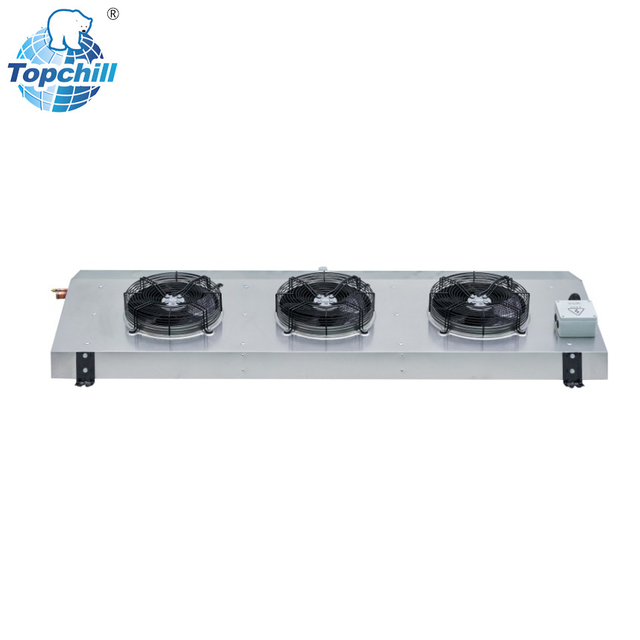
Tight spatial constraints require specific hardware solutions. A compact cold room air cooler offers a low-profile design. These units fit into modular walk-ins with low ceilings. You must weigh the trade-offs between physical footprint and CFM output. Smaller fans move less air. You must place these units carefully to avoid short-cycling. Do not mount them too close to adjacent walls. Ensure high-stacked products do not block the discharge path. Compact units require clear, unobstructed lanes to function properly. They serve well in restaurant walk-ins where space commands a premium, but they fail in high-density industrial warehouses.
You must differentiate systems based on the sensitivity of your stored product. Packaged goods tolerate aggressive airflow. Fresh produce and florals require gentle handling. High-velocity systems ensure deep penetration in dense racking. They push cold air through tight pallet spacing. Low-velocity systems prevent moisture stripping in unpackaged goods. They maintain high humidity levels without drying out the product. Select the velocity profile that matches your inventory. Mismatching velocity to product type guarantees inventory loss and operational failure.
Basic cooling capacity does not guarantee proper airflow. You must evaluate CFM, static pressure, and throw distance together. Long rooms demand aggressive air movement. For distances over 30 feet, specify dual or triple fan configurations. These units should deliver at least 1,200 CFM at 0.5 inches of static pressure. High static pressure pushes air past physical obstructions. It ensures the cold air reaches the back wall. If you ignore static pressure, the air simply drops to the floor halfway across the room.
Measure the total length of the room from the fan discharge to the opposing wall.
Consult the manufacturer's throw distance charts at your specific operating static pressure.
Verify that the terminal velocity at the far wall remains above 50 feet per minute to ensure proper return circulation.
Install air straighteners on the fan guards if the air stream disperses too quickly.
Modern hardware offers significant operational savings. You should look for an energy efficient air cooler to reduce long-term overhead. Evaluate units equipped with Electronically Commutated (EC) motors. EC motors consume a fraction of the power used by traditional shaded-pole motors. Variable speed fan controls allow the system to ramp down during low-load periods. Smart defrost algorithms represent another major upgrade. They respond to actual frost thickness on the coil. This prevents unnecessary heating cycles driven by outdated mechanical timers.
The temperature difference between the coil and the room air dictates humidity levels. You must evaluate this Temperature Delta (TD) based on product type. A standard 10-12°C delta works well for general packaged goods. It removes enough moisture to keep the room dry. Fresh produce requires a much tighter TD to maintain high humidity. Extreme applications demand different calculations. Operating in a -40°C deep freeze environment changes everything. Moisture freezes instantly upon contact with the coil. You must design for rapid frost mitigation and aggressive airflow recovery.
Product Category | Target Room Temperature | Recommended Temperature Delta (TD) | Humidity Goal |
|---|---|---|---|
Packaged Meats / Dairy | 2°C to 4°C | 10°C - 12°C | Moderate (75% - 85%) |
Leafy Greens / Vegetables | 0°C to 2°C | 6°C - 8°C | High (90% - 95%) |
Deep Freeze Storage | -20°C to -25°C | 10°C - 15°C | Low (Moisture removal is priority) |
Coil fin spacing determines how long your system runs between defrosts. You measure this in Fins Per Inch (FPI). Select your FPI based on target temperature and expected moisture load. A 4 FPI coil works best for freezers and high-humidity coolers. The wider spacing prevents rapid ice bridging. It allows air to flow even when frost accumulates. A 6 FPI coil suits dry, medium-temperature storage. Tighter fins offer more surface area for heat exchange. They choke quickly if introduced to high moisture loads. Meat processing facilities often drop to 3 FPI to handle the massive steam loads generated during washdown shifts.
Physical obstructions destroy intended airflow patterns. Perpendicular racking acts as a massive baffle. Over-stacked pallets block the air stream completely. When air hits a solid wall of product, it deflects downward and creates severe dead zones behind the rack. You must mitigate this during the layout phase. Align your longitudinal airflow parallel to the racking aisles. The air must travel down the open lanes. Enforce strict maximum load heights. Maintain a minimum 18-inch clearance between the top of the pallets and the ceiling. Forklift operators need clear visual markers to prevent them from stacking product into the air stream.
Short-cycling occurs when supply air bounces off nearby obstructions. The cold air immediately returns to the intake coil. This tricks the thermostat into shutting down the system prematurely. The area near the unit freezes, while the corners of the room remain warm. To mitigate this, utilize a cold storage evaporator equipped with adjustable louvers. Direct the airflow away from immediate obstacles. Ensure minimum clearance distances from adjacent walls. Never install a unit in a tight corner where air cannot expand.
High-traffic doors introduce massive thermal loads. Warm, moist air enters the room every time the door opens. This disrupts the internal airflow loop immediately. The moisture travels straight to the coldest surface and ices the coil. You must mitigate infiltration aggressively. Place the unit away from direct alignment with main doors. Do not let the fans pull outside air straight into the intake. Integrate industrial air curtains over all high-traffic entryways. Strip curtains also provide a physical barrier against moisture migration.
Install high-velocity air curtains on the warm side of the doorway.
Mount the cooling unit at least fifteen feet away from the main loading doors.
Angle the fan discharge away from the door opening to prevent creating a vacuum effect.
Use rapid-roll doors to minimize the total open time during forklift traffic.
Conduct a comprehensive heat load calculation to determine exact CFM and static pressure requirements before purchasing equipment.
Map out all pallet positions and racking orientations on the floor plan to ensure parallel airflow alignment with the fan discharge.
Specify variable-speed EC motors and smart defrost controllers on your equipment schedule to reduce off-peak energy consumption.
Consult a refrigeration engineer to verify throw distance capabilities if your storage room exceeds 30 feet in length.
Establish and enforce strict stacking height limits with your warehouse team to maintain a clear return air path at the ceiling level.
A: The industry standard requires 20 to 30 air turns per hour. You calculate this by dividing the total room volume by the fan's CFM output. High-density product loads require higher air turns to ensure penetration. Low-density storage operates efficiently closer to the 20-turn baseline.
A: Poor placement causes supply air to bounce off walls and return immediately to the coil. This short-cycling creates localized humidity pooling. The moisture freezes rapidly, causing severe coil frosting. This necessitates frequent defrost cycles, which introduces heat and causes erratic temperature fluctuations.
A: Yes, but you must select the right profile. Standard units blow directly onto top-tier products, causing freezer burn. In low-clearance spaces, use low-profile or center-mounted dual-discharge units. These designs pull air from the middle and blow outward, preventing direct downward drafts.
A: Standard commercial units typically cover up to 30 feet effectively. Beyond this distance, the air velocity drops, creating warm dead zones at the far end of the room. For longer rooms, you must specify specialized high-throw units featuring dual or triple fans and higher static pressure.
A: Deep freeze environments cause ambient moisture to freeze instantly upon contact with the coil. This requires much wider fin spacing, typically 4 FPI or lower, to prevent rapid ice bridging. You also need highly robust defrost mechanisms to clear the ice and restore proper airflow quickly.
A: Racking orientation dictates how air moves through the space. If aisles run parallel to the airflow, they channel the cold air efficiently to the back wall. If racks sit perpendicularly, they act as physical baffles, blocking the air and creating severe warm zones behind the pallets.
A: Short-cycling is primarily caused by blocked return air paths or poor unit placement. If supply air deflects off high-stacked pallets or nearby walls, it feeds directly back into the intake. Oversized units also drop the immediate air temperature too quickly, tricking the thermostat into shutting off early.