Views: 0 Author: Site Editor Publish Time: 2026-06-30 Origin: Site


In deep freezing applications operating between -18°C and -30°C, equipment failure directly translates to compromised product integrity, severe energy waste, and costly downtime. Standard refrigeration units are not engineered for the rapid frost accumulation and extreme thermal dynamics of deep freezing. Facility managers and engineers must navigate complex technical specifications—from fin spacing to defrosting mechanisms—to prevent ice bridging and maintain uniform temperatures. Selecting the correct Ceiling-Mounted Air Cooler requires a rigorous evaluation of thermodynamic requirements, spatial constraints, and long-term operational demands. This guide provides a framework for evaluating and specifying the right unit for industrial and commercial deep freeze environments.
Establishing a reliable cold storage facility begins with defining the exact operational parameters required by the inventory. A successful deep freeze environment must maintain strict temperature tolerances while managing continuous thermal loads from various sources.
You must establish the specific temperature requirements and acceptable variance for the stored product. Medical and pharmaceutical storage often requires ultra-low temperatures with zero tolerance for fluctuation. In contrast, a typical frozen food storage cooler might operate optimally at -20°C but can withstand minor variances during defrost cycles. Defining this baseline dictates the required cooling capacity and the sensitivity of the control systems you need to implement on site.
Accurate heat load calculation is mandatory for system longevity. You must factor in multiple sources of heat ingress to size the equipment correctly. Failing to account for any of these variables results in undersized equipment that runs continuously without ever reaching the setpoint.
Cold air must reach every corner of the room to prevent product spoilage. High-velocity air circulation is required to penetrate densely packed pallets and prevent localized hot spots. The system must generate enough static pressure to push cold air through racking systems, ensuring that inventory stored in the center of a pallet receives the same cooling effect as items on the perimeter. Proper airflow mapping prevents dead zones where frost and heat can accumulate.
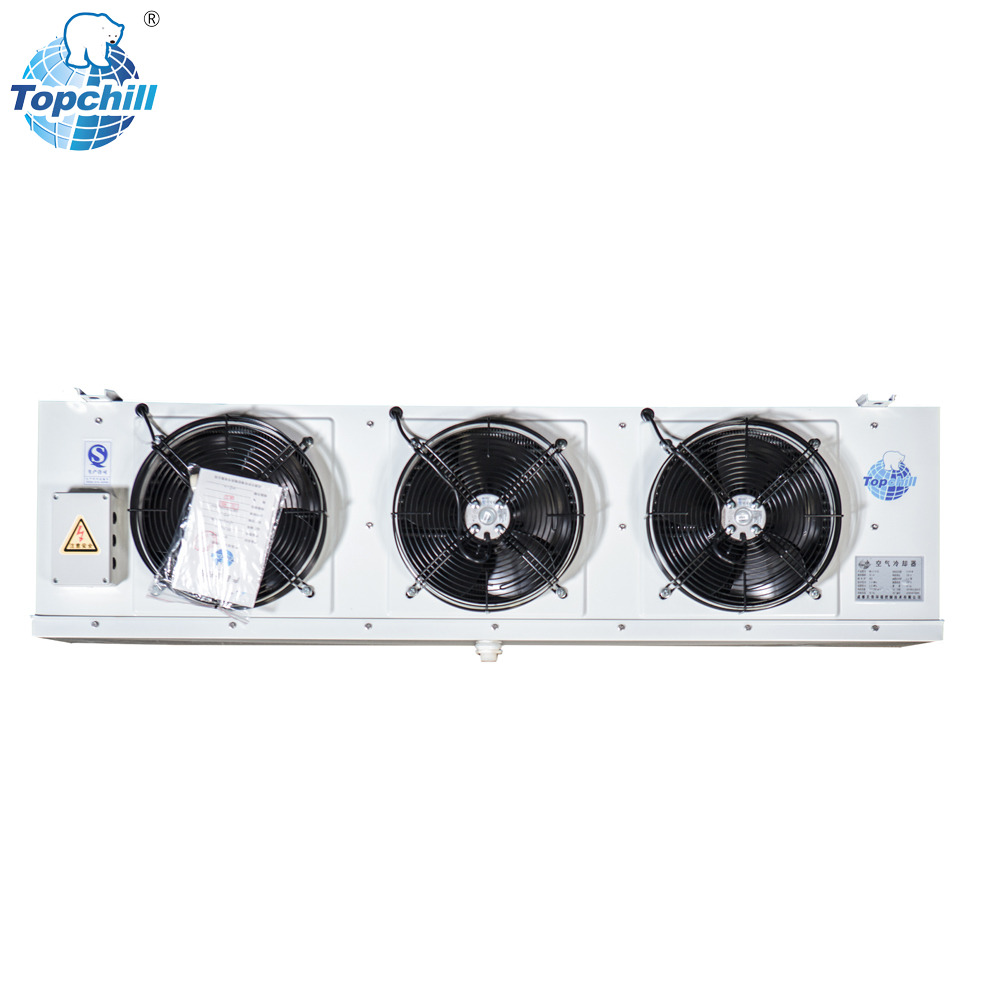
The internal architecture of a low temperature cold room cooler determines its ability to handle sub-zero conditions without succumbing to ice blockages or mechanical failure. Component selection directly impacts field performance.
Fin density directly impacts how quickly frost accumulates on the evaporator coil. Standard 4mm spacing fails in deep freezers because the narrow gaps quickly bridge with ice, choking off airflow and forcing the compressor to work harder. For sub-zero applications, 7mm to 12mm fin spacing is the industry standard. This wider gap allows the unit to operate longer between defrost cycles, maintaining a more consistent room temperature.
The 5-row coil design utilizing 9.52mm copper tubes has become a benchmark for efficiency. This specific geometry optimizes refrigerant velocity and internal volume, maximizing heat transfer efficiency within a compact casing. It provides the necessary surface area for rapid heat exchange without requiring a massive, space-consuming unit that eats into vertical storage capacity.
Thermal conductivity and durability drive material selection in industrial refrigeration. Copper tubes offer superior heat transfer rates and can withstand the high pressures of modern refrigerants. Aluminum is typically used for the fins to keep the overall unit weight manageable while maximizing the heat exchange surface area. Depending on the storage environment, anti-corrosive coatings are essential. Epoxy-coated fins or full stainless steel casings protect the equipment in harsh environments, such as coastal areas with high ambient salinity or facilities storing high-acid foods.
Axial fan specifications must align with the room's dimensions. You need to evaluate the air throw distance and cubic feet per minute (CFM) requirements relative to the room length. EC (Electronically Commutated) motors provide significant advantages over traditional AC motors. They offer variable speed control, draw less power, and generate less internal heat. Fan blade diameter configurations must match the overall room square footage to guarantee complete air exchange and prevent stagnant air pockets.
Ice accumulation is inevitable in deep freezing. How a ceiling evaporator manages this ice dictates its overall efficiency and the stability of the room temperature.
| Defrost Type | Mechanism | Field Application Notes |
|---|---|---|
| Electric Defrost | Stainless steel heater elements inserted directly into the coil block and drain pan. | High reliability and simple installation. Carries high operational energy consumption and risks localized heat transfer to the cold room. |
| Hot Gas Defrost | Reverses refrigeration cycle to pump hot discharge gas through evaporator coils. | Highly efficient and rapid melting. Minimizes room temperature spikes but requires complex control valves and extensive piping. |
| Water Defrost | Sprays a controlled volume of water over the coils to melt frost. | Effective for high-capacity industrial setups. Introduces severe freezing risks in drain lines if not perfectly pitched and heated. |
Electric defrost systems utilize stainless steel heater elements inserted directly into the coil block and the drain pan. They offer high reliability and a lower initial equipment cost. However, they carry high operational energy demands. The intense heat generated can also transfer into the cold room, causing temporary temperature spikes that the compressor must subsequently overcome.
Hot gas defrost works by reversing the refrigeration cycle, pumping hot discharge gas from the compressor directly through the evaporator coils. This method is highly efficient and rapid, melting ice from the inside out. It minimizes room temperature spikes and reduces energy consumption compared to electric heaters. The trade-off is complexity; it requires specialized control valves, additional piping, and higher upfront installation labor.
Water defrost involves spraying a controlled volume of water over the coils to melt the accumulated frost. While highly effective for specific industrial setups with massive capacity demands, it introduces significant risks in deep freeze environments. If the drain lines are not perfectly pitched, heavily insulated, and heat-traced, the defrost water will freeze, leading to blocked drains, overflowing pans, and severe damage to the equipment.
Proper physical placement of a deep freezer air cooler is just as critical as its internal specifications. Poor positioning leads to short-cycling, severe icing, and ruined inventory.
Ceiling-mounted installations offer superior airflow dynamics. They provide top-down, radial air distribution that covers the room more evenly than the directional flow of wall-mounted systems. Furthermore, ceiling mounting maximizes usable vertical pallet storage space. By keeping the equipment overhead, you eliminate the risk of physical damage from forklifts navigating tight aisles.
Many cold rooms face spatial limitations. Angled ceiling air coolers with low-height, compact profiles are specifically designed to maximize vertical storage in small cold rooms with low ceiling clearances. When installing these units, you must assess clearance requirements around the casing. Adequate space behind the coil is mandatory for optimal return airflow and to provide technicians with sufficient access for routine maintenance.
Units must be positioned strategically away from active doorways. Placing an evaporator too close to a door guarantees immediate moisture ingress, leading to rapid coil frosting and constant defrost cycles. You must also size the fan configuration based on room length. Map out multi-fan configurations for rooms exceeding standard air throw limits. Implement multiple fan systems for rooms longer than 18 feet (5.5 meters) to ensure the cold air reaches the back wall, eliminating dead zones and ensuring uniform cooling across all stored inventory.
Evaluating the long-term viability of refrigeration equipment requires looking beyond the initial purchase price. Operational efficiency is dictated by component selection and maintenance accessibility.
The trade-off between standard AC motors and high-efficiency EC motors is a primary consideration. While EC motors carry a higher initial capital expenditure, their variable speed capabilities and lower power draw significantly reduce daily energy consumption. Calculating the break-even point based on continuous operation usually justifies the upgrade for deep freeze environments.
Evaluate the design of the unit's casing. Features like hinged drip trays, easily removable side panels, and swing-down fan panels drastically reduce labor hours during routine cleaning and component replacement. Equipment that is difficult to service will inevitably suffer from deferred maintenance, leading to premature failure.
Intelligent, demand-based defrost controllers use sensors to detect actual ice thickness on the coils. This technology reduces unnecessary heating cycles compared to traditional time-based defrost clocks. By only initiating a defrost when physically required, the system saves energy and maintains a more stable room temperature.
Installing heavy refrigeration equipment in sub-zero environments introduces specific structural and operational risks that require proactive mitigation.
A major risk involves heavy, ice-laden units compromising insulated metal panel (IMP) ceilings. As frost builds up between defrost cycles, the weight of the unit increases significantly. To mitigate this, mandate structural load assessments before installation. Specify appropriate suspension hardware, backing plates, and thermal break mounts to distribute the weight safely and prevent thermal bridging through the ceiling panels.
Melted frost refreezing in the drain pan or piping is a catastrophic failure point. This leads to ice build-up that blocks airflow and can eventually shatter fan blades. Mitigate this risk by specifying heated, sloped drain pans. Ensure all drain lines are heat-traced, heavily insulated, and routed directly out of the freezing zone with an external P-trap to prevent warm air from migrating back up the pipe.
A ceiling-mounted air cooler in a deep freeze setting is a highly engineered component that dictates the viability, efficiency, and safety of the entire cold storage operation. The decision matrix requires careful balancing of thermodynamic needs and physical constraints.
A: For deep freezing applications (-18°C and below), a minimum fin spacing of 7mm to 12mm is required to accommodate frost buildup between defrost cycles without restricting airflow.
A: Ceiling evaporators for cold storage are built with wider fin spacing, specialized 5-row coil geometries, integrated heavy-duty defrost mechanisms, and specialized fan motors designed to operate continuously in sub-zero temperatures.
A: Units should be mounted flush against the ceiling, blowing air down the longest unobstructed length of the room, and positioned away from primary doors to minimize the intake of warm, moist ambient air.
A: Rapid ice buildup is typically caused by insufficient fin spacing, excessive door openings allowing moisture infiltration, a malfunctioning defrost cycle, or improper unit sizing leading to continuous compressor operation.
A: Yes, copper tubes provide superior thermal conductivity and durability under high-pressure refrigerants, while aluminum fins are used to keep the unit lightweight and maximize the heat exchange surface area.
A: The number of fans is dictated by the room's length and overall volume. For rooms longer than 18 feet (5.5 meters), multi-fan units or multiple separate coolers are required to ensure the air throw reaches the back wall.
A: Yes. Angled ceiling air coolers feature a low-profile, compact design specifically engineered for rooms with low ceiling heights, allowing you to maximize storage space while maintaining proper return airflow.


