Views: 0 Author: Site Editor Publish Time: 2026-07-08 Origin: Site


Industrial processes operating at extreme low temperatures face unique thermal management challenges. Whether supporting pharmaceutical crystallization, chemical synthesis, cannabis extraction, or food flash-freezing, maintaining precise temperature control dictates product viability. Minor temperature deviations result in catastrophic product loss or complete process failure. Achieving temperatures down to -40°F (-40°C) requires specialized engineering to manage energy consumption, prevent excessive maintenance downtime, and avoid premature equipment failure. Standard comfort HVAC chillers, typically designed for 40°F to 45°F leaving fluid temperatures for air handling units, cannot handle the thermal dynamics, fluid viscosity changes, and continuous-run demands of sub-zero applications. Specifying a Low-Temperature Water-Cooled Chiller requires moving beyond basic capacity matching. It demands a rigorous technical evaluation of compressor architecture, refrigerant properties, and facility infrastructure to ensure reliable, continuous operation.
Understanding the difference between leaving fluid temperature (LFT) and the actual required process temperature at the heat exchanger interface is the first step in system design. The chiller must produce fluid colder than the target process temperature to account for heat transfer inefficiencies and thermal losses across the piping network. If a chemical reactor requires a jacket temperature of -20°F, the chiller's LFT might need to be -25°F or -30°F depending on flow rates and pipe insulation quality.
Calculating peak versus partial thermal loads accurately prevents oversizing. An oversized chiller will short-cycle, leading to accelerated compressor wear, poor oil return, and erratic temperature control. Unlike comfort cooling HVAC systems, which experience highly variable loads based on ambient weather and building occupancy, low temperature process cooling typically presents stable, continuous load profiles. Designing the equipment to match these steady-state industrial demands ensures consistent performance and extends mechanical lifespan.
| Parameter | Standard HVAC Chiller | Low-Temperature Process Chiller |
|---|---|---|
| Leaving Fluid Temp (LFT) | 40°F to 45°F | 20°F down to -40°F |
| Heat Transfer Fluid | Treated Water | High-Concentration Glycol or Synthetics |
| Load Profile | Highly variable (weather dependent) | Stable, continuous 24/7 operation |
| Insulation Requirement | Standard elastomeric | Thick closed-cell with heavy vapor barrier |
In refrigeration cycles, "lift" refers to the pressure and temperature differential the compressor must overcome between the low-pressure evaporator and the high-pressure condenser. Operating at low temperatures inherently increases this lift, forcing the compressor to work harder and consume more electrical power. Lowering the condenser water supply temperature, typically provided by a cooling tower, directly reduces the overall lift the compressor must achieve.
Reducing lift significantly improves system efficiency. As a general engineering rule, every one-degree Fahrenheit drop in condenser water temperature yields a 1.5% to 2% improvement in compressor efficiency. Managing condenser water temperatures effectively through optimized cooling tower operation and variable speed condenser pumps is a primary strategy for reducing electrical consumption in sub-zero applications.
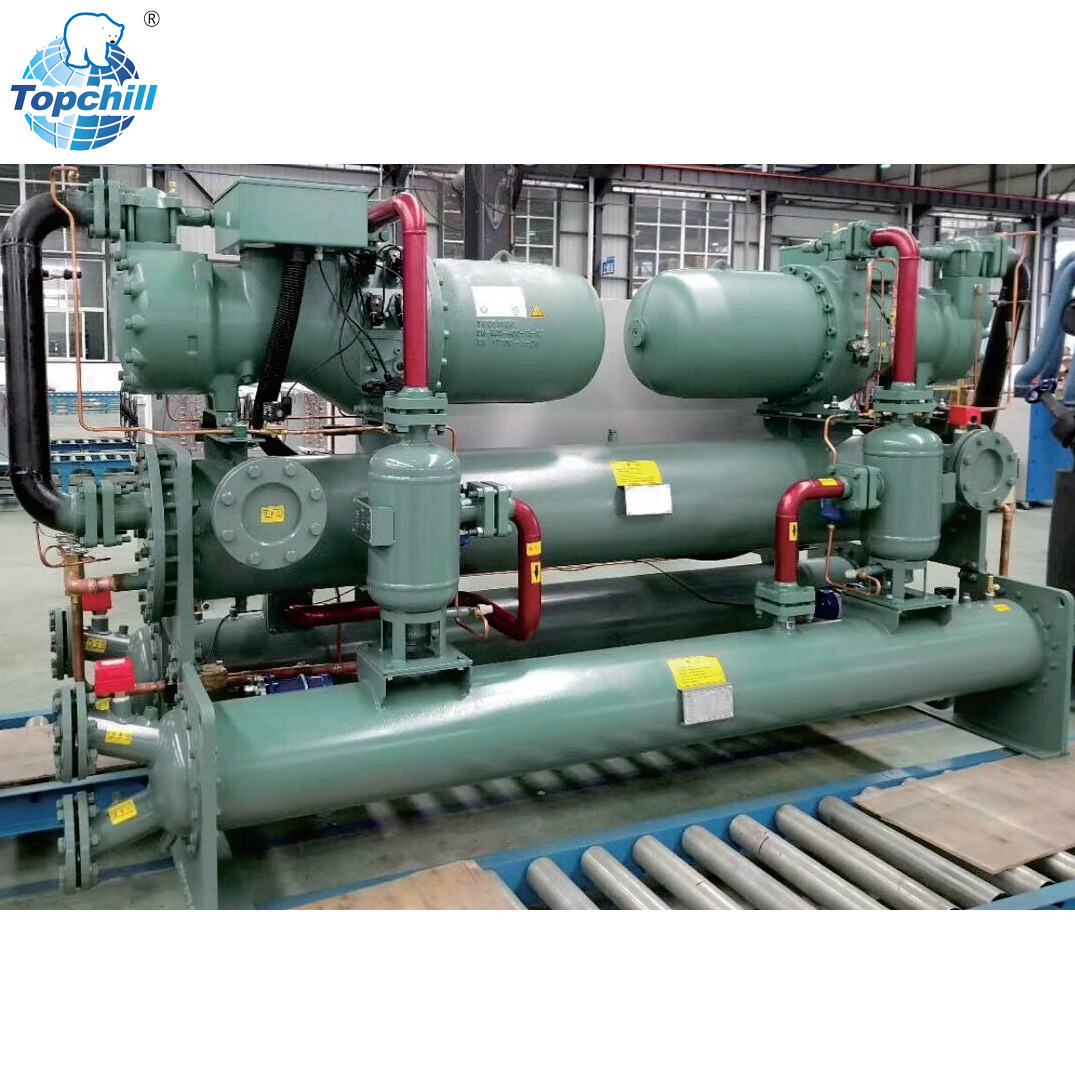
Compressor selection dictates the reliability and efficiency of the entire thermal management system. Scroll, screw, and centrifugal compressors each offer different performance characteristics. For extreme low-temperature applications, managing high compression ratios is the primary mechanical challenge. A semi hermetic water chiller design provides distinct operational advantages. The motor is cooled by suction gas, enhancing durability under heavy loads, and the bolted casing design entirely eliminates external shaft seal leaks, which are common failure points in open-drive compressors.
Furthermore, semi-hermetic compressors allow for robust field serviceability. Maintenance technicians can rebuild internal components, replace valve plates, or swap stators without removing the entire compressor block from the piping circuit. When target temperatures drop between -10°F and -40°F, standard single-stage compression often becomes inefficient or mechanically unviable due to excessive discharge temperatures. These extreme thresholds typically require economizers or two-stage compression systems to manage heat and maintain volumetric efficiency.
Selecting the correct evaporator involves evaluating shell-and-tube versus brazed plate heat exchangers. Shell-and-tube designs are mechanically robust, handle fluid fouling better, and are easier to clean using mechanical tube brushes. Brazed plate heat exchangers offer superior heat transfer in a highly compact footprint but are extremely sensitive to particulate fouling and catastrophic freezing. The increased viscosity of low-temperature fluids must factor heavily into this decision, as it directly affects pressure drop and internal flow dynamics.
Proper insulation is an absolute requirement, not an optional upgrade. Closed-cell insulation with robust, seamless vapor barriers prevents condensation, corrosion under insulation (CUI), and destructive ice buildup on the evaporator shell and suction piping. Failing to insulate properly leads to rapid equipment degradation, severe thermal losses, and hazardous puddling on the mechanical room floor.
Heat rejection efficiency heavily influences overall plant performance. Water possesses a significantly higher heat transfer coefficient than ambient air. Consequently, a water cooled chiller operates more efficiently, particularly when managing the high heat loads generated by low-temperature industrial processes. Water-cooled systems maintain stable condensing pressures even during extreme summer ambient conditions, ensuring reliable, continuous cooling when air-cooled units might struggle, derate capacity, or trip on high head pressure.
By utilizing a cooling tower, water-cooled systems can take advantage of wet-bulb temperatures, which are consistently lower than dry-bulb temperatures during peak summer months. This thermodynamic advantage keeps the compressor lift manageable and electrical consumption predictable year-round.
Choosing between air-cooled and water-cooled systems involves significant infrastructure trade-offs. Water-cooled units require dedicated mechanical room space, cooling towers, chemical water treatment programs, and condenser water pumps. Conversely, air-cooled units require substantial outdoor roof or pad space, structural support to handle their operating weight, and adequate clearance for proper airflow without recirculation.
For facilities located near residential areas or subject to strict municipal noise ordinances, indoor water-cooled systems offer substantial acoustic benefits. Containing the heavy compressors inside a sound-attenuated mechanical room and utilizing low-noise cooling tower fans mitigates environmental noise pollution effectively.
Selecting the right refrigerant requires balancing thermodynamic performance with shifting environmental regulations. Low-temperature applications require refrigerants with suitable temperature glide, low boiling points, and high volumetric capacity. Options include R-507A alternatives, R-448A, R-449A, or natural refrigerants like Ammonia (R-717) and CO2 (R-744). Facility managers must evaluate Global Warming Potential (GWP) and Ozone Depletion Potential (ODP) against upcoming EPA AIM Act and F-Gas regulatory phase-downs to ensure long-term compliance and avoid expensive future retrofit costs.
Standard water freezes at 32°F, making it useless for sub-zero applications. Fluid selection—typically Ethylene Glycol, Propylene Glycol, or specialized synthetic heat transfer fluids—dictates the freezing point and specific heat capacity of the circulating loop. Increased fluid viscosity at low temperatures creates significant pumping challenges. It requires upsized pump motors to overcome friction, alters Net Positive Suction Head (NPSH) requirements, and lowers the Reynolds number.
If the Reynolds number drops too low, fluid flow shifts from turbulent to laminar inside the heat exchanger. Laminar flow creates an insulating boundary layer against the tube walls, drastically reducing heat transfer efficiency. Engineers must carefully calculate pump curves and pipe diameters to maintain turbulent flow at the lowest expected operating temperature.
Advanced controls are essential for maintaining stability in an industrial chiller system. Precise capacity modulation via Variable Frequency Drives (VFDs), rapid response from electronic expansion valves (EEVs), and hot gas bypass for low-load stability are critical features. Seamless BMS/SCADA integration using protocols like BACnet or Modbus enables real-time monitoring of approach temperatures, oil pressure differentials, and overall system diagnostics. This data allows operators to preemptively address performance degradation before it causes an unplanned shutdown.
Evaluating industrial cooling equipment requires looking far beyond the initial purchase price. Electrical energy consumption accounts for the vast majority of a unit's lifetime operating expense. Calculating the return on investment (ROI) for premium efficiency options, such as VFDs on compressors and condenser pumps, involves analyzing the Integrated Part Load Value (IPLV) and site-specific run hours. Investing in high-efficiency components upfront yields substantial long-term operational savings, especially in facilities running continuous 24/7 production shifts.
Protecting high-value processes from unplanned downtime requires robust redundancy planning. Evaluating modular configurations versus N+1 redundant single-unit systems determines the facility's mechanical resilience. Furthermore, designing the piping infrastructure with "rental-ready" utility connections allows for rapid recovery during emergencies. Installing isolation valves, bypass loops, and quick-connect flange fittings allows maintenance teams to seamlessly integrate temporary mobile chillers during scheduled major overhauls or sudden capacity upgrades without halting production.
The physical design of the equipment directly impacts serviceability and ongoing maintenance costs. Adequate tube pulling clearance for condenser cleaning, easy compressor head access, and accessible oil filter and drier core replacement points reduce labor hours during routine service. Additionally, implementing a dedicated, chemically managed water treatment program for the condenser loop prevents scaling and biological fouling. Scale buildup acts as an insulator, which degrades heat transfer efficiency, drives up head pressure, and shortens compressor lifespan.
Evaporator freezing is a severe risk caused by improper glycol concentration, localized fluid stagnation, or sudden flow loss. Mitigating this risk requires installing dual-element flow switches, low-temperature safety cutouts, and automated fluid-density monitoring systems. Oil return failure is another common issue at low loads and low operating temperatures. Refrigerant vapor loses velocity at low loads, failing to carry oil back to the compressor. Utilizing high-efficiency oil separators, active oil management systems with heaters, and proper suction line piping design—such as correctly sized suction risers and P-traps—ensures consistent compressor lubrication.
Rigorous testing verifies system integrity before full deployment. Factory acceptance testing (FAT) under simulated low-temp loads ensures the unit meets design specifications before shipping. On-site Site Acceptance Testing (SAT) is equally critical. Verifying control sequences, safety interlocks, sensor calibration, and full-load performance guarantees the equipment operates safely and efficiently before integrating it into the active production line.
A: Standard units typically reach 40°F, but specialized low-temperature process cooling chillers utilizing specific refrigerants, two-stage compression, and high-concentration glycol or synthetic fluids can achieve temperatures down to -40°F/-40°C or lower.
A: Semi-hermetic compressors offer the hermetic seal benefit of preventing refrigerant leaks while allowing complete field serviceability of internal components, which is crucial for minimizing downtime in continuous industrial processes.
A: Colder condenser water reduces the pressure differential (lift) the compressor must overcome, significantly decreasing energy consumption, reducing mechanical wear on the system, and increasing overall reliability.
A: Low temperature process cooling involves specialized compressor designs, the absolute necessity of antifreeze mixtures, low-boiling-point refrigerants, thicker insulation with vapor barriers to prevent ice formation, and continuous 24/7/365 run-time duty.
A: As temperatures drop, fluid viscosity increases significantly. This requires larger pump motors to overcome increased pressure drops and can shift flow from turbulent to laminar, which severely reduces heat transfer efficiency in the evaporator.


