Views: 0 Author: Site Editor Publish Time: 2026-07-06 Origin: Site


Process cooling dictates the rhythm of modern manufacturing. When you improperly size your cooling equipment, the operational stakes are massive. You face immediate production bottlenecks, premature equipment failure, and excessive energy expenditure. Matching dynamic industrial heat loads with the specific performance curves of air-cooled systems is a complex engineering challenge. These systems operate in fluctuating ambient conditions that constantly shift their actual cooling output.
You need a systematic, engineering-based framework for accurate capacity calculation. This framework must be specifically tailored to the operational profile of semi-hermetic compressors. By understanding the core variables, you can design a system that maintains precise temperature control. A properly sized Air-Cooled Semi-Hermetic Chiller guarantees stable production, reduces mechanical wear, and optimizes your facility's energy consumption.
A successfully sized system delivers stable process temperatures and optimized compressor cycling. It minimizes maintenance overhead and strictly adheres to your facility energy budgets. Achieving this requires precise alignment between your heat load and the chiller's capabilities. When you hit this target, your manufacturing process runs without thermal interruptions. You avoid the frantic emergency calls when a line goes down because the cooling water is ten degrees too warm.
Oversizing your equipment introduces severe mechanical risks. An oversized unit cools the process fluid too quickly, leading to rapid short-cycling. This constant starting and stopping destroys semi-hermetic motor starters. It also prevents proper oil return to the compressor, causing catastrophic lubrication failures. Furthermore, you waste significant capital on unnecessary capacity and oversized electrical infrastructure. The compressor never runs long enough to establish a stable thermal equilibrium.
Undersizing carries equally destructive consequences. An undersized unit cannot keep up with the heat load, leading to thermal runaway. Your production lines will face emergency shutdowns as temperatures exceed safe limits. The compressor will run continuously at its maximum design limits. This relentless operation guarantees premature valve failure and inevitable motor burnout. You will constantly fight high-temperature alarms during peak summer months.
Semi-hermetic compressors handle capacity modulation exceptionally well. Both reciprocating and screw designs offer distinct advantages over fully hermetic alternatives. They utilize cylinder unloading, slide valves, and variable frequency drives to match variable industrial loads. A semi hermetic chiller adapts smoothly to changing production demands, maintaining efficiency even when running at partial capacity. This mechanical flexibility is why they dominate heavy industrial applications.
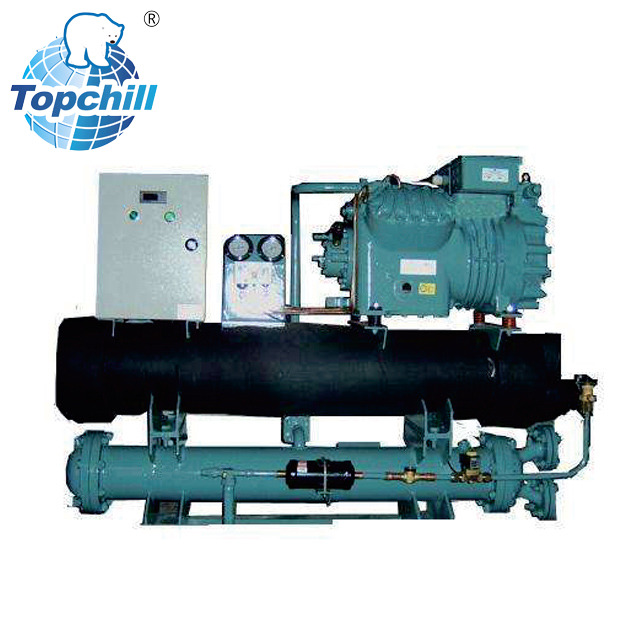
Determining your baseline cooling requirement involves strict mathematical and physical variables. You must evaluate flow rates, fluid properties, and temperature targets. Accurate chiller capacity sizing bridges the gap between theoretical calculations and real-world performance. You cannot guess these numbers; you must measure them directly from your process equipment.
To calculate the process heat load, you use a standard thermodynamic formula. The equation is: Load (BTU/hr) = Flow Rate (GPM) × 500 × Specific Gravity × Specific Heat × ΔT (°F). The constant 500 represents the weight of one gallon of water (8.34 lbs) multiplied by 60 minutes. This formula establishes your absolute minimum cooling requirement before any safety margins or environmental derating factors are applied.
Determining the exact flow rate and temperature differential (ΔT) requires analyzing your specific machinery. Injection molding machines, laser cutters, and fermentation tanks all have unique flow requirements. You measure the flow rate in gallons per minute (GPM). The ΔT is the difference between the fluid temperature entering and leaving your process equipment. You should use ultrasonic flow meters and calibrated temperature probes to get accurate field readings.
Introducing glycol significantly alters your fluid dynamics. A 30% or 50% propylene glycol mix reduces heat transfer efficiency. Glycol lowers the specific heat and increases fluid viscosity compared to pure water. You must apply a performance penalty to your calculations. This requires a proportional increase in chiller capacity and higher pump motor horsepower to maintain turbulent flow.
| Propylene Glycol % | Freeze Point (°F) | Capacity Derate Multiplier | Flow Rate Multiplier |
|---|---|---|---|
| 10% | 26°F | 0.98 | 1.02 |
| 20% | 18°F | 0.96 | 1.05 |
| 30% | 8°F | 0.93 | 1.09 |
| 40% | -7°F | 0.89 | 1.14 |
Your target evaporator leaving fluid temperature (LFT) directly impacts system capacity. Low LFT targets, such as those below 45°F, lower the saturated suction temperature (SST) of the compressor. A lower SST reduces the refrigerant mass flow rate. This physical limitation shrinks your capacity sizing margins, requiring a physically larger compressor to achieve the same tonnage. You must check the compressor envelope to ensure it can operate at your required SST.
Design calculations must account for inevitable fouling factors. Scaling, biological growth, and chemical deposition restrict heat transfer on evaporator tubes. You must size the system with standard fouling factors, typically 0.0001 to 0.00025 hr·ft²·°F/BTU. Incorporating these factors ensures your equipment maintains reliable cooling over years of continuous operation, even as the internal heat exchanger surfaces degrade slightly over time.
External variables routinely degrade the nominal capacity of an industrial air cooled chiller. You cannot rely on laboratory ratings for field installations. Implementation realities demand rigorous adjustments for climate, elevation, and physical site constraints. A unit that works perfectly in Ohio will fail miserably in Arizona if not properly derated.
Nominal chiller ratings are typically based on a 95°F ambient temperature. Facilities in extreme climates must derate these nominal capacities. High ambient air increases condensing pressure and compressor power input. This thermodynamic relationship reduces your net cooling capacity. You must size the unit based on the highest historical ambient temperature for your specific location, adding a few degrees for safety.
Altitude physically reduces air density. At elevations above 1,000 feet, thinner air reduces the mass flow rate across the condenser coils. This limits the system's heat rejection capacity. You must apply altitude derating factors to your calculations. Failing to adjust for elevation will result in high-head pressure trips during peak summer operation, shutting down your entire process.
Airflow restrictions and microclimates dictate physical installation constraints. You must maintain minimum clearance dimensions around condenser coils. Walls, adjacent equipment, or solid fences cause hot-air recirculation. Recirculating hot exhaust air artificially raises the ambient temperature around the unit, severely crippling its cooling capacity and efficiency. Always follow the manufacturer's clearance guidelines strictly.
Industrial facilities operating year-round require specific low-ambient controls. When ambient temperatures drop below freezing, standard air-cooled units struggle to maintain adequate head pressure. You must specify flooded condenser logic or variable speed condenser fans. These controls ensure stable refrigerant flow and prevent low-pressure faults during winter operation, keeping your process running regardless of the weather outside.
Comparing structural configurations ensures you meet calculated loads, flexibility needs, and redundancy requirements. The right configuration prevents catastrophic downtime. You must evaluate compressor types, circuit designs, and coil specifications based on your specific site environment. Do not just buy the cheapest option; buy the configuration that matches your operational risk profile.
Selecting between reciprocating and screw compressors depends on your load profile. Semi-hermetic reciprocating compressors are ideal for lower tonnage applications requiring stepped unloading. Semi-hermetic screw compressors excel in larger, continuous process loads. Screw compressors provide stepless modulation, allowing them to precisely match fluctuating high-capacity industrial demands without excessive cycling.
| Compressor Type | Best Application | Capacity Modulation | Maintenance Profile |
|---|---|---|---|
| Semi-Hermetic Reciprocating | Low to medium tonnage, variable loads | Stepped (Cylinder Unloading) | Fully rebuildable in the field |
| Semi-Hermetic Screw | High tonnage, continuous process | Stepless (Slide Valve / VFD) | Longer intervals, specialized rebuilds |
Dual-circuit systems provide critical operational security. A single-circuit system leaves your entire process vulnerable to a single component failure. Redundant refrigerant circuits prevent total process failure during routine maintenance. If one compressor faults, the second circuit continues providing partial cooling, keeping your production lines moving while you wait for replacement parts or a service technician.
Condenser coil and fan specifications must match your environmental conditions. Microchannel coils offer lightweight, high-efficiency heat transfer but are sensitive to galvanic corrosion. Fin-and-tube coils with protective coatings are mandatory for corrosive environments like coastal or chemical plants. Electronically Commutated (EC) fans provide precise head pressure control while reducing electrical draw, making them a smart upgrade for variable ambient conditions.
Local noise ordinances often impose sound attenuation restrictions. Site constraints can limit maximum fan speeds. You may need to specify acoustic blankets for the compressors or low-noise fan blades. You must understand that these noise mitigation packages can slightly impact air-cooled condenser efficiency by restricting airflow or trapping heat around the compressor body.
Evaluating long-term operational impact requires looking beyond the initial capital expenditure. A process cooling chiller rarely runs at 100% capacity continuously. Therefore, full-load efficiency is rarely the most critical metric for industrial applications. You need to understand how the machine performs when the load drops to 50% or 75%.
Integrated Part Load Value (IPLV) and Non-Standard Part Load Value (NPLV) provide a more accurate efficiency picture. These metrics measure energy consumption at various partial loads. Since industrial loads fluctuate with production schedules and ambient temperatures, optimizing for IPLV guarantees lower monthly utility bills and better overall system performance across the entire calendar year.
The core value proposition of a semi-hermetic design lies in its maintenance and rebuild capabilities. You can open the compressor casing in the field. Technicians can replace valves, pistons, gaskets, and motors without removing the entire block. You contrast this with hermetic scrolls, which you must completely discard and replace upon any internal failure, leading to longer downtime and higher replacement costs.
Refrigerant lifecycle considerations heavily influence equipment selection. The industry is rapidly transitioning to low-GWP (Global Warming Potential) refrigerants. Compressor design directly affects refrigerant charge volume and potential leak rates. Selecting modern, compliant refrigerants ensures future regulatory compliance and prevents expensive retrofits as older gases phase out of production.
Even perfectly sized units fail during the installation phase if infrastructure is ignored. Implementation risks compromise flow rates, electrical stability, and temperature control. You must proactively address piping, loop integration, and electrical demands before the unit arrives on site. A great chiller cannot fix a terrible piping system.
Undersized facility piping creates massive pressure drops. Excessive fittings, sharp elbows, or incredibly long pipe runs restrict fluid movement. The chiller's internal pump cannot overcome these severe pressure drops. This leads to inadequate flow rates through the evaporator, causing the unit to trip on low-flow or freeze-protection alarms. You must calculate the total dynamic head of your entire piping network.
Integrating a new unit into a legacy primary/secondary cooling loop requires careful planning. You must stabilize return water temperatures to prevent thermal shock to the new compressors. Using hydraulic separators and adequately sized buffer tanks decouples the primary production loop from the chiller loop. This ensures stable flow and consistent temperature delivery, regardless of what the process equipment is doing.
Semi-hermetic motors demand massive inrush currents during startup. This high-current demand tests your electrical infrastructure compatibility. Across-the-Line starting often causes site-wide voltage dips, disrupting sensitive manufacturing equipment. You should specify Part-Winding, Star-Delta, or Soft Starters to reduce inrush current and protect your facility's power grid from massive spikes.
Sizing an air-cooled semi-hermetic chiller is a rigorous engineering exercise. It requires exact heat load calculations, environmental derating, and precise fluid dynamic planning. You cannot rely on guesswork when your production output is on the line. Procurement and engineering teams must prioritize transparency and demand customized performance data.
A: A hermetic compressor is completely sealed and welded shut; if it fails, it must be discarded. A semi-hermetic compressor is bolted together. It allows technicians to open the casing in the field to replace motors, valves, and shaft seals. This rebuildability makes semi-hermetic units highly desirable for demanding industrial settings.
A: First, calculate your load in BTU/hr using the formula: GPM × 500 × Specific Gravity × Specific Heat × ΔT. Once you have the total BTU/hr, divide that number by 12,000. One refrigeration ton equals exactly 12,000 BTU/hr. For example, a 120,000 BTU/hr load requires a 10-ton chiller.
A: High ambient temperatures reduce a chiller's ability to reject heat. As outside air gets hotter, condensing pressures rise. This forces the compressor to work harder, increasing power consumption while simultaneously decreasing the net cooling capacity. You must derate the chiller's nominal capacity for high-temperature climates.
A: Glycol provides essential freeze protection and corrosion inhibition for industrial piping. However, glycol has a lower specific heat and higher viscosity than pure water. This reduces heat transfer efficiency. You must upsize the chiller evaporator, condenser, and internal pump to compensate for glycol's thermal penalties.
A: The standard ΔT for industrial applications is typically between 10°F and 15°F. This range optimizes heat exchanger design and compressor efficiency. Deviating from this range significantly impacts your flow rate requirements. A smaller ΔT requires a massive increase in fluid flow to achieve the same cooling tonnage.
A: Buffer tanks add necessary thermal mass to the cooling loop. When process loads drop suddenly, the extra fluid volume absorbs the excess cooling capacity. This slows down the rate of temperature change, stabilizing return temperatures and preventing the semi-hermetic compressors from rapidly turning on and off.
A: At higher altitudes, the air is thinner and less dense. Lower air density reduces the mass of air flowing across the condenser coils, which severely limits heat transfer. To compensate for this reduced heat rejection capability, you must apply an altitude derating factor and potentially upsize the compressor.


