Views: 0 Author: Site Editor Publish Time: 2026-07-23 Origin: Site


Inadequate airflow in commercial refrigeration creates immediate operational risks. Temperature stratification, product spoilage, and compressor overexertion often stem from poor air distribution rather than insufficient cooling capacity. As facilities expand, standard single-fan units struggle to push air through complex room geometries, high-traffic zones, and dense product stacking. These environments create dead zones that a single fan simply cannot penetrate, leaving perishable inventory vulnerable to localized warm spots. Upgrading to a multi-fan configuration offers a targeted solution for specific load requirements. However, this decision must rely on precise calculations of heat load, air throw, and redundancy needs rather than arbitrary upgrades. Understanding when to specify multiple fans ensures optimal performance, protects sensitive inventory, and maximizes the efficiency of your refrigeration cycle.
Air Throw and Geometry Dictate Fan Count: Long, narrow rooms or spaces with complex shelving require multiple fans to ensure uniform air distribution and prevent localized warm spots.
Capacity Thresholds: Multi-fan units are generally mandatory when cooling loads exceed the CFM (Cubic Feet per Minute) and BTU/hr limits of a single-fan standard unit cooler.
Built-in Redundancy: A multi-fan configuration prevents catastrophic temperature loss; if one fan motor fails, the remaining fans maintain partial airflow until maintenance occurs.
Avoid the Diminishing Returns Trap: Adding more fans to a fixed physical coil footprint does not scale cooling capacity infinitely; it can introduce parasitic motor heat and disrupt static pressure.
Energy and Maintenance Trade-offs: While multiple fans increase initial capital expenditure and maintenance touchpoints, integrating EC (Electronically Commutated) motors yields a high efficiency air cooler that lowers long-term operational costs.
The mechanical function of the Evaporator coil relies entirely on forced convection. Refrigerant absorbs heat as it passes through the copper tubes. The rate of this heat transfer depends on how effectively fans move ambient air across the aluminum fins. A single fan creates a localized cooling profile. It pushes a concentrated column of cold air straight ahead. This works well for small, unobstructed walk-ins. However, as room volume increases, this single column disperses too quickly. It fails to reach the corners of the room.
Multi-fan arrays change this dynamic by generating overlapping airflow patterns. Instead of one aggressive column of air, multiple fans create a wide, uniform wall of cold air. This sweeps across the entire refrigerated space. This distinction brings up the balance between airflow velocity and airflow volume. Pushing air too fast can dehydrate sensitive products like fresh produce or meats. Moving a higher volume of air evenly across a broader surface area cools the room without causing product damage. You must match the fan output to the specific product requirements.
You must understand the law of diminishing returns when evaluating fan configurations. Simply mounting more fans to a standard unit without increasing the physical surface area of the coil fails to improve capacity. The compressor and the coil dictate the maximum heat absorption. Furthermore, excessive fan motors introduce parasitic heat load into the refrigerated space. Every motor generates heat during operation. If the coil cannot absorb that additional heat alongside the room's natural heat load, the extra fans actively degrade system performance.
Configuration Type | Airflow Profile | Best Application | Limitations |
|---|---|---|---|
Single-Fan Unit | Narrow, concentrated column | Small walk-ins, low traffic | Poor corner reach, zero redundancy |
Dual-Fan Unit | Moderate overlapping plumes | Medium prep rooms, standard aisles | Struggles with very high ceilings |
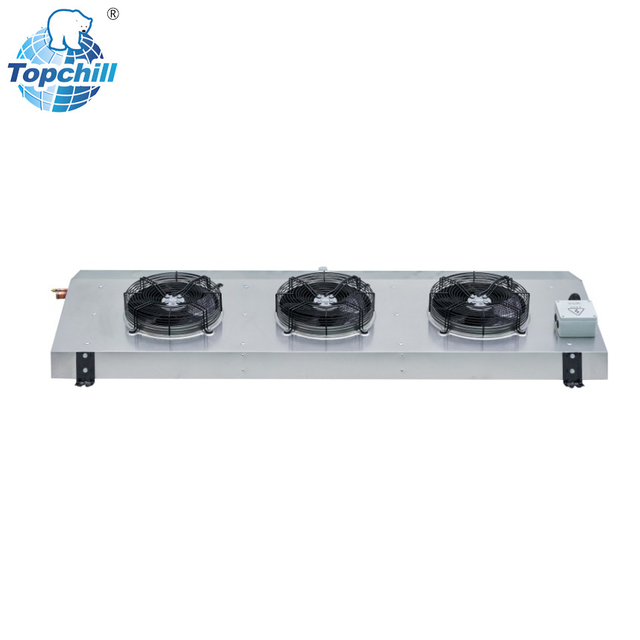
Multi-Fan Array (3+) | Wide, uniform wall of air | Large cold storage, blast freezers | Higher structural weight, complex wiring |
When designing a system, engineers look at the sensible heat ratio. This ratio determines how much moisture the system pulls from the air. Multi-fan setups allow for better control over this ratio. By adjusting fan speeds across multiple motors, you can fine-tune the humidity levels. This prevents excessive frost buildup on the fins. It also keeps the product from drying out. Proper fan management directly impacts the longevity of the equipment.
Airflow resistance plays a major role in fan selection. Dense fin spacing on the coil creates high static pressure. Fans must overcome this pressure to move air effectively. Single fans often struggle against high static pressure unless they run at very high RPMs. High RPMs generate excessive noise and vibration. Multiple fans running at lower speeds can overcome the same static pressure quietly. This makes them ideal for occupied spaces where noise levels matter.
Room dimensions directly dictate the required air throw. To determine if multiple fans are necessary, measure the distance from the unit face to the furthest opposing wall. A single fan's throw typically becomes ineffective beyond 20 to 30 feet. This depends on the fan blade diameter and motor horsepower. When the room depth exceeds this threshold, a multi-fan commercial refrigeration evaporator becomes necessary. It pushes conditioned air all the way to the back wall. This ensures it circulates properly back to the return side of the coil.
High-traffic zones and infiltration barriers demand robust airflow. Layouts near loading docks, frequently opened walk-in doors, or high-humidity entryways face constant thermal disruption. Every time a door opens, warm, moisture-laden air infiltrates the space. A multi-fan array maintains a continuous thermal barrier. It sweeps away infiltrating warm air before it can settle over the stored product. Single fans simply lack the volumetric coverage to protect wide door openings.
High cooling load demands further necessitate multiple fans. Scenarios involving high-temperature product loading require massive amounts of CFM. Blast chilling or rapid pull-down requirements need high airflow to strip heat from the product quickly. High ambient external temperatures also increase the transmission load through the insulated panels. This requires higher airflow to maintain setpoints. You must calculate the total heat rejection required before selecting the fan count.
Zonal cooling and difficult geometries make multi-fan units indispensable. Environments with dense racking systems, low ceilings, assembly lines, or L-shaped rooms obstruct linear airflow. Dense pallets block air, creating severe temperature gradients. Multiple directional fans are required to push air down different aisles or around corners. This eliminates dead zones that would otherwise lead to product spoilage. Proper placement ensures every pallet receives adequate cooling.
Measure the total room length, width, and height to determine total cubic volume.
Identify all heat sources, including lighting, forklifts, personnel, and product infiltration.
Calculate the required air changes per hour based on the specific product stored.
Map out racking layouts to identify potential airflow obstructions and dead zones.
Select a fan configuration that provides overlapping coverage across all aisles.
Air distribution must account for product stacking heights. If pallets are stacked too close to the ceiling, they block the return air path. This causes the cold air to short-cycle back into the fans. Multi-fan units require clear pathways above the product. Installers must leave at least 18 inches of clearance between the top of the product and the ceiling. This allows the air to travel to the back wall and return smoothly.
Return air temperature sensors rely on proper air mixing. If a single fan fails to mix the air in a large room, the sensor reads an inaccurate temperature. It might read cold while the corners of the room are warm. Multiple fans ensure the air mixes thoroughly. This provides the sensor with an accurate representation of the average room temperature. Accurate readings prevent the compressor from short-cycling and save energy.
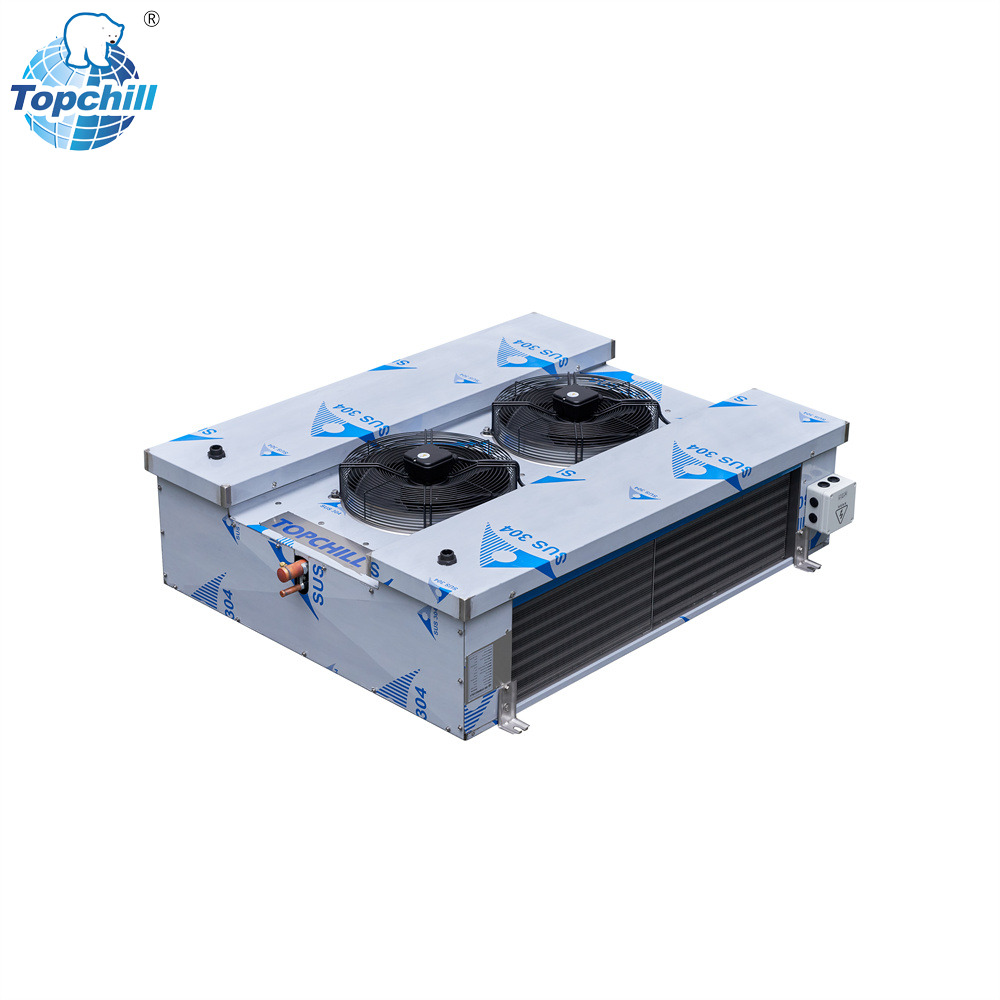
Selecting the right equipment requires matching the fan configuration to the specific application. A standard unit cooler with a dual-fan setup is typically deployed in standard walk-in coolers and medium-sized prep rooms. These units provide enough volumetric coverage to handle moderate foot traffic and standard shelving layouts. They do this without overcomplicating the installation. They are reliable workhorses for everyday commercial applications.
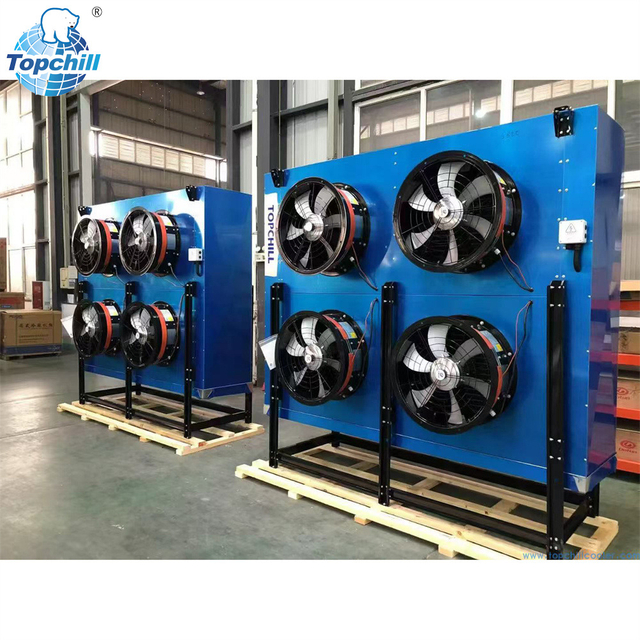
For large-scale cold storage, distribution centers, and blast freezers, industrial multi-fan arrays are required. These 3-to-5 fan configurations move massive volumes of air across expansive square footage. They are engineered to handle heavy frost loads and rapid temperature recovery. This makes them the backbone of heavy-duty cold chain logistics. They utilize heavy-gauge aluminum or stainless steel housings to withstand harsh industrial environments.
Medium temperature applications present unique challenges. A durable medium temperature air cooler operating between 34°F and 38°F must manage humidity just as strictly as temperature. In these environments, multiple fans help maintain a high sensible heat ratio. This prevents excessive condensation on the product and the room surfaces. Proper fan spacing and blade pitch ensure that moisture is effectively managed without freezing the coil prematurely.
In some facilities, hybrid airflow ecosystems offer the best performance. This involves pairing a primary cooling unit with complementary secondary air movers. Industrial ceiling fans or HVLS (High Volume Low Speed) fans work well here. Secondary fans help destratify the air in large, high-ceiling rooms. However, they do not replace the need for a dedicated multi-fan high efficiency air cooler when the primary throw velocity at the coil face is insufficient to reach the product zones.
Application Type | Recommended Fan Count | Primary Goal | Motor Type Preference |
|---|---|---|---|
Restaurant Walk-in | 1 to 2 Fans | Basic temperature maintenance | Standard or EC |
Meat Prep Room | 2 to 3 Fans | Low velocity, high humidity control | EC Motors (Variable) |
Distribution Warehouse | 4 to 5 Fans | Maximum air throw, rapid recovery | High-Torque EC |
Blast Freezer | 3 to 5 Fans | Extreme heat removal, high CFM | Heavy-Duty Industrial |
Blade design impacts performance significantly. Swept-blade designs reduce turbulence and noise. Straight blades push air aggressively but generate more sound. When selecting a multi-fan unit, consider the blade pitch. A steeper pitch moves more air but requires a stronger motor. Matching the blade design to the motor output ensures the fans operate at peak efficiency without burning out prematurely.
Fan shrouds direct the airflow. A poorly designed shroud allows air to spill out the sides, reducing the effective throw distance. Deep-drawn venturi shrouds channel the air into a tight, focused column. This maximizes the distance the air travels before dispersing. When evaluating multi-fan units, inspect the shroud construction. Heavy-duty shrouds prevent vibration and ensure the air goes exactly where it is needed.
The primary feature of a multi-fan array is its overlapping fan plumes. This translates directly to the operational outcome of strict temperature compliance. In sectors like pharmaceutical storage or perishable food processing, a temperature deviation of just a few degrees can ruin an entire batch of inventory. Overlapping plumes ensure that cold air blankets the room evenly. This eliminates the hot and cold spots that plague single-fan setups.
Defrost cycle efficiency improves with multiple fans. During an air defrost cycle, fans continue to run while the compressor is off. They use the ambient room air to melt frost off the coil. Multiple fans pull a larger volume of this ambient air across the entire surface of the coil simultaneously. This speeds up the defrost process. It minimizes system downtime and reduces the duration of temperature fluctuations within the room.
Acoustic impact and noise compliance represent another critical performance dimension. In occupied spaces like food preparation rooms or packaging lines, worker comfort and safety are paramount. One massive, high-RPM fan generates a significant decibel output and disruptive vibration. Conversely, multiple smaller fans running at lower speeds can move the same volume of air while generating a much lower noise footprint. This ensures compliance with workplace acoustic standards.
Overlapping air plumes eliminate dead zones in corners.
Faster air defrost cycles reduce compressor off-time.
Lower RPM multi-fan setups decrease overall decibel levels.
Even air distribution prevents localized product dehydration.
Consistent return air temperatures prevent compressor short-cycling.
Vibration isolation extends equipment life. Multi-fan units generate harmonic frequencies. If these frequencies match the natural frequency of the mounting structure, severe vibration occurs. Installers use neoprene isolation pads or spring hangers to dampen this vibration. Proper isolation prevents the vibration from transferring into the building structure. It also protects the copper piping from stress fractures caused by constant shaking.
Airflow modulation provides precise control. Advanced systems use variable frequency drives (VFDs) or EC motors to adjust fan speed based on real-time demand. When the room reaches the setpoint, the fans slow down. They maintain air circulation without overcooling the space. This modulation reduces energy consumption and extends the life of the fan motors. It represents a significant upgrade over traditional on/off fan controls.
Long-term operational efficiency hinges on the technology driving the fans. Modern multi-fan units equipped with EC (Electronically Commutated) motors drastically reduce energy consumption. These motors allow for precise airflow modulation. They draw significantly less power during off-cycles compared to traditional shaded-pole motors. This efficiency translates directly to lower daily energy usage. It aligns with sustainability goals and reduces grid strain.
The redundancy premium offers massive operational value through risk mitigation. In a single-fan unit, a motor failure results in an immediate and total loss of airflow. The coil freezes, the room temperature spikes, and the inventory is lost. In a multi-fan configuration, if one motor fails, the remaining fans continue to pull air across the coil. While the system operates at a reduced capacity, it maintains a partial thermal barrier. This prevents immediate thermal runaway and buys critical time for maintenance teams to arrive.
Maintenance complexities must be managed proactively. Operating multiple motors, blades, and fan guards means more moving parts that require inspection and cleaning. To keep maintenance predictable and streamlined, facilities should standardize their equipment. Using units with identical, easily swappable fan motors reduces the need to stock multiple different replacement parts. It simplifies the troubleshooting process for on-site technicians.
Maintenance Task | Single-Fan Unit | Multi-Fan Unit | Frequency |
|---|---|---|---|
Blade Cleaning | Quick, single access point | Requires cleaning multiple blades | Quarterly |
Motor Replacement | System shutdown required | Can often run on remaining fans | As needed |
Bearing Lubrication | One motor to service | Multiple motors to service | Bi-Annually |
Vibration Check | Simple visual inspection | Requires checking harmonic balance | Monthly |
Coil cleaning requires specific chemicals. Technicians use non-acidic, foaming coil cleaners to push dirt out from between the fins. With multi-fan units, the coil surface area is larger. Technicians must ensure the cleaner penetrates the entire depth of the coil. Rinsing thoroughly prevents chemical residue from corroding the aluminum fins. Regular cleaning maintains the heat transfer efficiency and prevents the fans from working harder than necessary.
Fin combing restores airflow. Over time, physical impacts or high-pressure washing can bend the delicate aluminum fins. Bent fins block airflow and increase static pressure. Technicians use specialized fin combs to straighten the fins. This simple maintenance task restores the original airflow profile. It ensures the multi-fan array can push air through the coil without unnecessary restriction.
Upgrading to multiple fans introduces structural and mechanical challenges. Multi-fan units are heavier and generate more harmonic vibration than single-fan models. Installing these units requires reinforced mounting hardware and structural engineering sign-offs. You must ensure the ceiling panels or support beams can handle the dynamic load. Failing to secure the unit properly can lead to structural sagging or catastrophic equipment drops. Use heavy-duty strut channels and appropriately sized all-thread rods.
Electrical phasing and wiring complexities also increase. Improper electrical load balancing across multiple motors can trip breakers or cause premature motor burnout. Multi-motor units require dedicated circuits, appropriately sized contactors, and precise phased wiring. Technicians must ensure that all fans rotate in the correct direction. They must verify that the voltage drop across the array remains within acceptable tolerances. Use proper gauge wire to handle the combined amperage draw.
Preventing short-cycling and airflow interference is critical during installation. If a multi-fan unit is positioned too close to an opposing wall or a massive ceiling obstruction, the high-velocity air bounces back. It gets pulled directly into the return side of the coil before circulating through the room. This short-cycling tricks the thermostat into shutting off the compressor prematurely. Installers must optimize the clearance between the unit face and any obstructions. Strictly adhere to the manufacturer's specified air throw distances.
Verify ceiling load capacity with a structural engineer before mounting heavy multi-fan units.
Install vibration isolation pads between the mounting hardware and the ceiling structure.
Wire fan motors through properly sized contactors to handle the combined inrush current.
Verify fan rotation direction immediately upon startup to ensure proper airflow.
Measure voltage at each motor terminal to ensure balanced power distribution.
Adjust defrost termination sensors to account for the increased airflow during off-cycles.
Drain line routing requires careful planning. Multi-fan units generate more condensate during defrost cycles. The drain pan must slope correctly toward the drain line. The drain line itself must be sized to handle the increased water volume. Install heat trace tape on drain lines in freezer applications to prevent freezing. A clogged or frozen drain line causes water to overflow into the fan blades, creating a massive mess and damaging the motors.
Clearance around the unit dictates serviceability. Technicians need room to access the motors, heaters, and expansion valves. Installing a multi-fan unit tight against a side wall makes maintenance impossible. Leave at least two feet of clearance on the header end of the coil. This allows technicians to braze pipes or replace the expansion valve without removing the entire unit from the ceiling.
Perform a formal heat load calculation to determine the exact CFM and BTU/hr requirements of your space.
Map your facility's airflow pathways, identifying dead zones, dense racking areas, and high-infiltration doorways.
Measure the distance from the proposed installation point to the furthest wall to establish your minimum air throw requirement.
Consult with a commercial refrigeration engineer to select the precise fan configuration and motor type that matches your operational needs.
A: Calculate the total room volume in cubic feet. Determine the required air changes per hour based on your specific product type and heat load. Multiply the room volume by the air changes per hour, then divide that number by 60 minutes to find the baseline CFM required for the space.
A: No. Fans only distribute air; total cooling capacity is strictly limited by the compressor size and the physical surface area of the coil. Adding more fans to a fixed coil yields diminishing returns and introduces unwanted parasitic motor heat into the refrigerated space.
A: Yes. In large prep rooms or distribution areas, secondary HVLS or ceiling fans can complement the primary cooling unit by aiding air destratification. However, they cannot substitute for the primary throw velocity required at the coil face to push conditioned air through the room.
A: Standard industry ranges for dual-fan units typically fall between 40 to 60 feet. However, the exact distance depends heavily on the fan motor horsepower, the aerodynamic design of the fan shroud, and the pitch of the fan blades.
A: Yes. EC motors drastically reduce energy consumption during off-cycles and allow for precise airflow modulation. This efficiency lowers daily operational power draw and qualifies the system as a high-efficiency unit, making the initial investment highly beneficial over the equipment's lifespan.
A: Multiple fans can be sequenced or utilized to distribute ambient room air more evenly across the coil during an off-cycle air defrost. This broad volumetric coverage speeds up the melting process, reducing downtime and minimizing the runtime of electric defrost heaters if equipped.
A: Yes, this is a primary benefit of multi-fan configurations. If one motor fails, the unit will continue to operate at a reduced capacity. This maintains a partial thermal barrier and prevents immediate thermal runaway while you await maintenance.