Views: 0 Author: Site Editor Publish Time: 2026-07-03 Origin: Site


Selecting the correct condensing unit architecture directly impacts operational reliability and compliance with local environmental regulations. Mismatched equipment often leads to premature mechanical failure, excessive energy consumption, or severe regulatory noise violations. Facility managers and refrigeration engineers constantly face the challenge of balancing spatial constraints, environmental exposure, acoustic limits, and maintenance accessibility when specifying a cold room refrigeration unit.
Two primary architectural categories dominate the market: box type and open type condensing units. This guide provides an objective, engineering-focused framework for evaluating which design aligns with specific facility requirements and cooling loads. By understanding the structural and operational differences, you can engineer a refrigeration system that maximizes uptime and meets site-specific demands.
A Box Type Condensing Unit is a fully enclosed, compact system. It houses the compressor, condenser coil, condenser fans, and electrical panel within a robust galvanized or powder-coated steel casing. This structural design prioritizes protection and spatial efficiency. The aesthetic and protective design offers a modern, clean-profile exterior. This makes the equipment highly suitable for commercial areas where units remain visible to the public or clients. Standard inclusions typically feature factory-wired control panels, built-in acoustic lining, adjustable control systems, and integrated safety switches. These components are engineered for rapid, plug-and-play deployment.
When deploying these units in the field, technicians notice the immediate benefit of pre-packaged components. The factory assembly reduces the number of brazing joints required on-site. This minimizes the risk of refrigerant leaks. The internal layout routes copper piping efficiently to prevent vibration fatigue. Engineers often specify these units for rooftop installations where weather resistance is non-negotiable. The powder-coated steel casing resists salt spray in coastal environments and prevents rust accumulation over years of operation.
An open type condensing unit utilizes an exposed chassis. Components such as the compressor, liquid receiver, oil separator, and accumulator are mounted directly onto an open structural steel base plate. It lacks a protective outer shell. These units are standard in indoor mechanical rooms or large-scale industrial refrigeration setups. In these environments, the building infrastructure entirely handles weatherproofing and environmental protection, allowing the equipment to operate without external enclosures.
The exposed nature of the open design provides unparalleled access for maintenance personnel. You can visually inspect every weld, valve, and electrical connection without removing a single panel. This architecture supports heavy-duty applications where massive semi-hermetic compressors are necessary to handle high cooling loads. The structural steel base plate absorbs the significant torque and vibration generated by these large compressors. Installers typically mount these units on vibration isolation pads bolted directly to a concrete housekeeping pad.
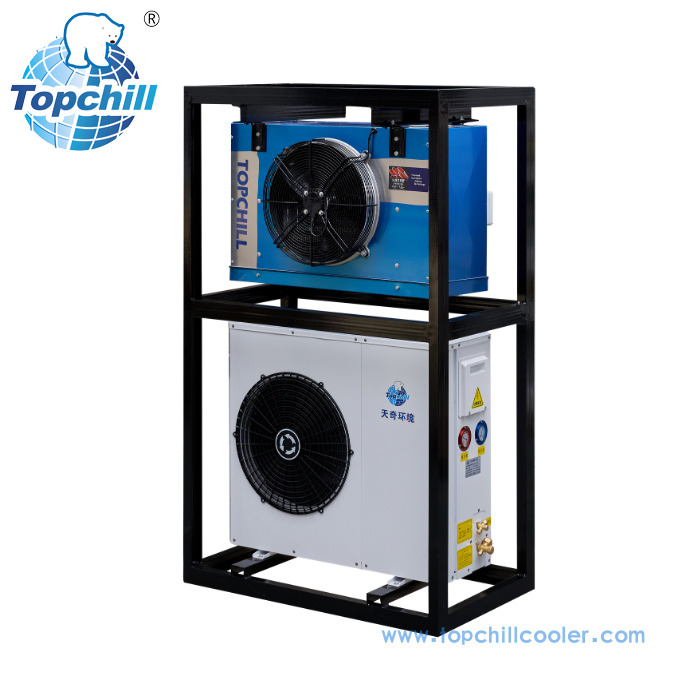
A box type condensing unit carries specific IP ratings for dust and water resistance. The rigid enclosure protects sensitive internal components, including variable frequency drives and contactors, from UV degradation, heavy rain, and wind-blown debris. This protection is critical for maintaining electrical integrity outdoors. The louvered panels direct airflow while preventing water ingress during heavy storms. Internal electrical boxes feature rubber gaskets to seal out moisture.
Conversely, open type units remain highly vulnerable to environmental factors if installed outdoors without a custom-built canopy or protective doghouse. Direct exposure rapidly leads to accelerated corrosion on the condenser coils and severe electrical degradation across exposed contact points. Dust accumulation on the condenser fins reduces heat transfer efficiency. If you must install an open unit outside, you have to construct a dedicated shelter. This adds labor and material requirements to the project.
Decibel output differs significantly between enclosed and exposed structures. Box types utilize thick sound-dampening insulation foam, isolated compressor compartments, vibration-absorber mounts, and low-speed sickle-blade fans. These features work together to meet strict municipal noise ordinances in populated areas. The compressor compartment is often completely sealed off from the condenser fan section. This prevents compressor noise from escaping through the fan grille.
Open types produce raw, unfiltered acoustic output. The exposed compressor and high-velocity fans generate substantial noise. If noise becomes an active constraint, these units require external, aftermarket sound attenuation strategies, such as acoustic louvers or dedicated soundproof plant rooms. In an industrial setting, this noise level is generally acceptable. However, placing an open unit near an office window or residential property line will result in immediate noise complaints.
Physical dimensions dictate installation flexibility. Box types are specifically engineered for high-density installation. They frequently utilize wall-mounting brackets or stackable configurations to maximize vertical space in cramped urban environments. The compact footprint allows you to install multiple units side-by-side on a narrow roof ledge. The directional airflow design means you only need clearance on the intake and exhaust sides.
Open types demand larger footprints and strict clearance requirements. Technicians must ensure adequate surrounding space to guarantee proper airflow and prevent condenser short-cycling. The lack of a directional enclosure means ambient air must flow freely around the entire chassis. You must leave at least three feet of clearance on all sides for maintenance access and airflow. This makes them unsuitable for tight alleyways or small mechanical closets.
| Feature | Box Type Condensing Unit | Open Type Condensing Unit |
|---|---|---|
| Weather Protection | Fully enclosed, IP-rated casing | None (requires indoor installation or custom shelter) |
| Acoustic Output | Low (insulated compartments, low-speed fans) | High (exposed compressor and fans) |
| Footprint | Compact, stackable, wall-mountable | Large, requires extensive clearance |
| Maintenance Access | Requires panel removal | 360-degree unobstructed access |
Box enclosures strictly dictate internal airflow paths. Fans pull air through specific louvers and push it across the condenser coil. However, there is a risk of internal heat build-up if these louvers become obstructed by debris or snow. You must maintain clear intake paths to ensure optimal condensing temperatures. Open type units draw ambient air without restriction, offering excellent thermal exchange efficiency as long as the mechanical room remains properly ventilated. They rely on the room's exhaust fans to remove the rejected heat.
Both architectures perform well in medium temperature applications, typically ranging from -5°C to +5°C. When specifying a medium temperature condensing unit for walk-in coolers or prep rooms, physical spatial limits often restrict box types to hermetic reciprocating or scroll configurations. Open types handle these temperatures easily and can utilize much larger compressors for massive distribution centers. The choice depends on the total heat load of the facility.
Cooling capacity limits dictate compressor choice. Smaller hermetic compressors fit seamlessly inside box units, making them ideal for commercial retail loads. Demanding, larger cold rooms require heavy-duty semi-hermetic compressors. Field-serviceability is a major differentiator. Semi-hermetic compressors, standard on open units, allow technicians to rebuild valves and replace internal parts on-site. Fully hermetic compressors, common in compact box units, are non-serviceable and require complete replacement upon failure.
The primary drawback of box units is restricted access. Technicians must remove multiple exterior panels to access the compressor, sight glasses, expansion valves, or filter driers. This physical barrier can complicate diagnostics and prolong standard service times during emergency breakdowns. You have to carry a drill and specific bits just to open the unit. Once inside, the compact layout makes it difficult to maneuver wrenches and brazing torches.
Open types provide immediate, 360-degree accessibility. This unobstructed layout facilitates rapid leak detection, easy oil level checks, and fast compressor valve replacements. Maintenance teams can visually inspect the entire system without removing a single screw. You can easily attach manifold gauges, check the oil sight glass, and test electrical contactors. This accessibility significantly reduces the time required for routine preventative maintenance.
Box types reduce on-site labor hours. They generally arrive pre-piped, pre-wired, and pressure-tested. This plug-and-play nature minimizes on-site electrical and brazing labor. Furthermore, they often feature integrated, pre-programmed electronic controllers that simplify commissioning. You simply connect the line set, wire the main power, and program the setpoint. The factory handles the complex internal wiring.
Open types require custom field-wiring and external control integration. Installers must mount separate control panels, run conduit, and manually configure the safety switches. This increases installation time but offers ultimate adjustability for complex, custom-engineered refrigeration cycles. You have complete control over the control logic, defrost cycles, and fan staging. This flexibility is necessary for industrial applications with varying load profiles.
Neither unit is objectively superior; the right choice depends entirely on installation location, local noise ordinances, and the scale of the cooling load. If the equipment goes outside in a populated area or requires instant weatherproof protection, default to a box type condensing unit. If it goes inside a dedicated mechanical room for a high-tonnage industrial application, default to an open type.
A: The primary advantage is its integrated weatherproofing, compact aesthetic footprint, and built-in acoustic attenuation. This makes it highly suitable for outdoor installations in urban or noise-sensitive environments without requiring additional protective structures.
A: Yes, but it requires significant modifications. You must add aftermarket weather housings, canopies, or protective doghouses to guard the exposed electrical and mechanical components from rain, UV rays, and environmental wear.
A: Box type units are significantly quieter. They feature thick acoustic insulation, isolated compressor compartments, and lower fan-blade speeds designed specifically to dampen operational noise and meet municipal sound ordinances.
A: Absolutely. They are highly suitable for walk-in coolers and prep rooms operating between -5°C and +5°C. They typically utilize scroll or hermetic compressors perfectly matched for these medium-temperature commercial loads.
A: Box types favor hermetic or scroll compressors due to strict internal space constraints. Open types easily accommodate massive, rebuildable semi-hermetic compressors required for heavy industrial duties and high-capacity cooling.
A: Maintenance on box types requires technicians to remove multiple exterior panels to reach internal components. Open types offer immediate, 360-degree access to all parts, allowing for faster visual inspections and rapid component replacements.


