Views: 0 Author: Site Editor Publish Time: 2026-03-02 Origin: Site


Evaporative coolers lower indoor temperatures by harnessing evaporative cooling, which uses water evaporation to cool the air. You see the most effective results in dry climates, where evaporation happens quickly. High humidity limits evaporative cooling because the air already holds too much moisture, making temperature drops smaller—often only 10°F to 13°F when humidity rises above 70%. In arid regions, demand for eco-friendly cooling grows, and many homeowners choose the best evaporative cooler for energy efficiency and comfort. If you want the most cooling, pay close attention to your local climate and humidity levels.
Evaporative coolers use water evaporation to lower indoor temperatures, especially effective in dry climates.
Humidity levels significantly affect cooling efficiency; lower humidity allows for greater temperature drops.
Regular maintenance, such as cleaning water pads, ensures optimal performance and extends the life of your cooler.
Choose the right type of evaporative cooler based on your climate: direct for dry areas, indirect for humid regions.
Proper ventilation is crucial; keep windows open to allow fresh air in and improve cooling effectiveness.
Calculate the appropriate size of your cooler based on room dimensions to ensure efficient cooling.
Evaporative coolers are eco-friendly, using less electricity and no harmful chemicals compared to traditional air conditioning.
Monitor local weather conditions to determine the best times to use your cooler for maximum comfort.
Evaporative cooling is a natural process that lowers air temperature by using water evaporation. You can see this effect when hot, dry air passes over a wet surface. The water absorbs heat from the air and turns into vapor, which cools the air. Unlike refrigeration systems, evaporative cooling does not use chemicals or compressors. Instead, it relies on the physical change of water from liquid to gas.
Evaporative cooling works by forcing hot dry air over a wetted pad, where water evaporation occurs.
The evaporation process removes heat from the air, resulting in a cooling effect.
The efficiency of evaporative cooling depends on the humidity of the surrounding air. Drier air allows for greater cooling.
Refrigeration systems use refrigerants that absorb heat through a phase change from liquid to gas. The process involves a continuous cycle where the refrigerant is compressed and cooled, releasing absorbed heat elsewhere. Refrigeration relies on the latent heat of vaporization, which allows for significant heat absorption without a temperature increase.
When water evaporates, it absorbs energy from its surroundings. This energy comes from the heat in the air. You can measure the heat absorbed during water evaporation using the formula ΔQ=m˙hLV, where m˙ is the evaporation rate and hLV is the enthalpy change (2415 kJ/kg). Under certain conditions, the heat absorption can reach 9.7 kW/m², which is much higher than the solar energy input of 1 kW/m².
A simple experiment shows how evaporative cooling works. If you place water in a container and let it evaporate, the temperature drops. For example, a control experiment recorded a temperature drop from 23.1 °C to 19.5 °C due to water evaporation. This cooling effect was 3.6 °C compared to conditions without evaporation.
You can feel evaporative cooling when you sweat. As sweat evaporates from your skin, it takes heat away, making you feel cooler.
Evaporative cooling happens all around you. Here are some common examples:
Cooling water using porous clay containers or canvas bags that allow evaporation to lower the temperature.
Street vendors in South Asia use evaporative cooling to keep soda and fruit cool.
Sitting under a tree feels cooler because water evaporates from the leaves.
You experience a cooling sensation when perspiration evaporates from your skin.
Water stored in porous or wet containers stays cooler than in metal or plastic containers due to evaporation.
These examples show how evaporative cooling works in nature and daily life. You can use this process to lower indoor temperatures, especially in dry climates.
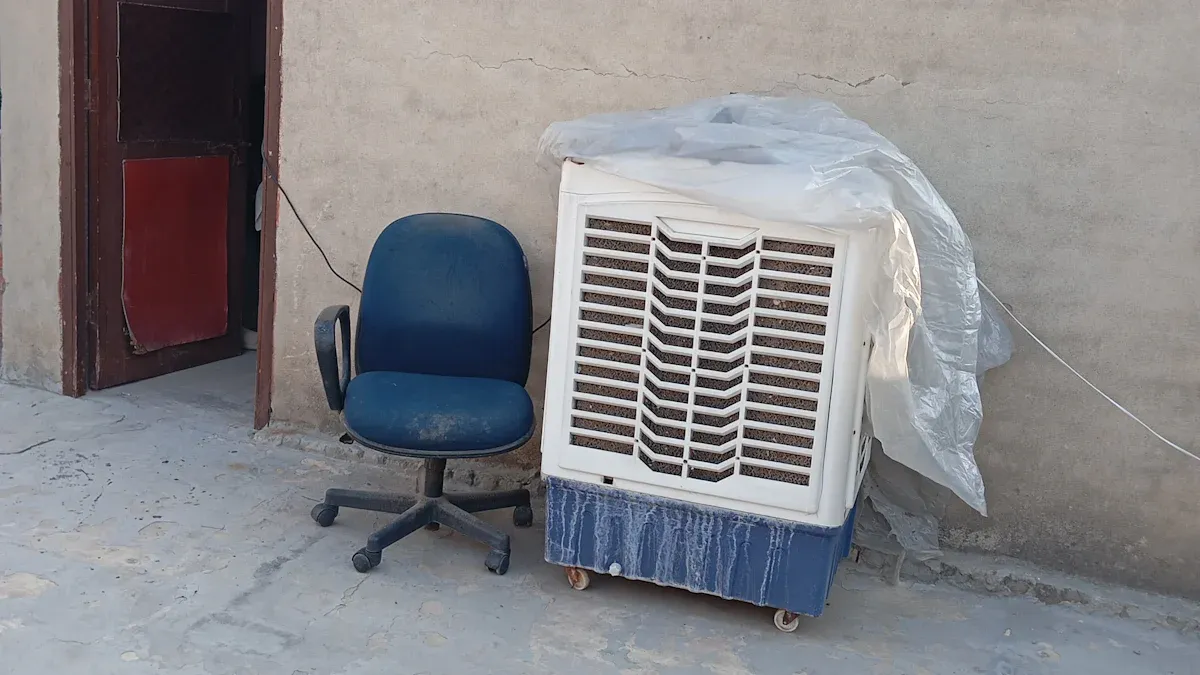
You can understand how an evaporative air cooler works by looking at its main parts. Each part plays a key role in the cooling process:
Water Reservoir: This tank holds the water that the cooler uses. The size of the reservoir determines how long your cooler can run before you need to refill it.
Fan: The fan pulls hot air from your room or outside into the cooler. It also pushes the cooled air back out into your space.
Water Pads: These pads soak up water from the reservoir. They provide a large, wet surface for the air to pass through, which is essential for effective evaporative cooling.
Tip: Clean the water pads regularly to keep your cooler working efficiently.
The cooling process in a swamp cooler happens in a few clear steps:
The fan draws in hot, dry air from your room or from outside.
This air passes through the water pads, which are already soaked with water from the reservoir.
As the hot air moves through the wet pads, the water begins to evaporate. This process absorbs heat from the air.
The fan then pushes the now-cool, moist air back into your room, creating a refreshing breeze.
You can feel the difference almost immediately, especially if you live in a dry climate. The air feels cooler and more comfortable because of the natural process of evaporative cooling.
When you use an evaporative cooler, you can expect a noticeable drop in temperature. The amount of cooling depends on the humidity and the temperature of the incoming air. In dry conditions, the temperature can drop by as much as 15°F to 25°F. The process works best when the air is hot and dry, because the water can evaporate quickly and absorb more heat.
Note: If the air is humid, the cooling effect will be less dramatic. The air cannot hold much more moisture, so less water evaporates and less heat is removed.
You can choose from several types of evaporative coolers for your home. Each type works best in different situations:
Direct Evaporative Coolers: These coolers use water-soaked pads to cool the air by evaporation. They work best in dry climates and are simple and energy-efficient.
Indirect Evaporative Coolers: These use a heat exchanger to cool the air without adding extra moisture. They are a good choice if you live in a humid area and want to improve air quality.
Two-stage Evaporative Coolers: These combine both direct and indirect methods. They offer better cooling and energy efficiency, even when humidity is higher.
You can find a cooler that fits your needs by considering your local climate and the size of your space. Evaporative cooling gives you an energy-saving way to stay comfortable during hot weather.
Humidity plays a major role in how well your evaporative cooler works. When you use this type of cooler in a hot, dry climate, you get the best results. The air in these regions holds little moisture, so water can evaporate quickly. This process removes more heat from the air, making your room feel much cooler. If you live in a humid area, you will notice that your cooler does not work as well. The air already contains a lot of moisture, so it cannot absorb much more. As a result, less water evaporates, and the cooling effect drops. Direct evaporative systems often struggle in these conditions. However, indirect or two-stage systems can still provide some cooling, even in coastal or humid regions.
You will see the highest efficiency from your evaporative cooler when the relative humidity stays below 40%. In these conditions, the cooler can lower the temperature by 15 to 30°F. This makes a big difference on hot summer days. You should also look for temperatures above 80°F for the best performance. When humidity rises above 70%, the cooling effect drops sharply. You might only see a small temperature decrease of 5 to 10°F. If you want to maximize comfort, use your cooler during the driest and hottest parts of the day. Open windows or doors to let fresh air flow through your space. This helps the cooler work at its best.
Tip: Check your local weather forecast for humidity levels before using your evaporative cooler. This simple step helps you plan for the most effective cooling.
Some climate conditions make evaporative coolers less effective. High humidity limits the cooling power, and you may need extra dehumidification to feel comfortable. In very hot climates, a single-stage cooler might not provide enough relief. You may need a multi-stage system for better results. The table below shows how different conditions affect performance:
Condition | Effect on Evaporative Coolers |
|---|---|
High Humidity | Cooling performance is limited; dehumidification needed |
Hot Climates | Single-stage cooling may be insufficient; multi-stage required |
You should always consider your local climate before choosing an evaporative cooling system. This helps you avoid disappointment and ensures you get the comfort you need.
You need a steady supply of fresh air for your evaporative cooler to work well. If you use the cooler in a closed room, the air becomes humid and sticky. The cooling effect drops because the air cannot hold more moisture. You should always keep a window or door open when running your cooler. This lets warm air escape and brings in fresh, dry air. When you allow proper ventilation, you help your cooler lower the temperature and keep the room comfortable.
Evaporative coolers require a continuous supply of fresh air to function effectively.
Without proper ventilation, humidity levels rise, leading to reduced cooling efficiency.
In a sealed room, the cooler recirculates humid air, making the environment uncomfortable and sticky.
Proper ventilation allows warm air to escape and fresh air to enter, improving cooling efficiency.
Tip: Open a window on the opposite side of the room from your cooler. This creates a cross-breeze and boosts the cooling effect.
You should match the size of your evaporative cooler to the size of your room. If you use a cooler that is too small, it will not cool the space enough. If you use one that is too large, you waste energy and water. To find the right size, multiply the square footage of your room by the ceiling height, then divide by two. This gives you the recommended CFM (cubic feet per minute) for your cooler.
For optimal performance, choose a cooler with a CFM rating that is 20-40 times the square footage of the room.
Example: A room of 500 square feet requires a cooler with at least 10,000 CFM.
The usual formula to calculate the swamp cooler size is: Square feet needed to be cooled X ceiling height (in feet), divided by two.
Good airflow also matters. Place your cooler near an open window or door to draw in dry air. Make sure nothing blocks the vents or fan. This helps your cooling systems work at their best and keeps the air moving.
Regular maintenance keeps your evaporative cooling system running smoothly. You should check and clean the water pads at least once before the cooling season and again after it ends. Replace pads and filters if they look worn or clogged. Clean the water reservoir and distribution system to prevent mineral buildup. This stops blockages and keeps water flowing well.
Water quality management: Treat and check water to prevent mineral buildup that can reduce cooling efficiency.
Environmental considerations: Check for weather and debris that may affect the pads and adjust maintenance as needed.
Regular cleaning: Clean your cooler at least once per season to prevent clogging and ensure optimal water flow.
Service your cooler at least twice a year—once before and once after the cooling season.
Note: Regular care extends the life of your cooling systems and helps you enjoy reliable, energy-efficient comfort.
You gain several advantages when you use evaporative coolers in dry climates. These cooling systems use up to 80% less electricity than traditional air conditioners, which means you save money on your energy bills. You also help the environment because these coolers do not use harmful chemicals or refrigerants. Instead, they rely on water to cool the air, which reduces your carbon footprint.
You enjoy lower installation and maintenance costs. Most units are simple to set up and do not require expensive repairs.
The added moisture in the air can relieve dry skin and reduce allergy symptoms.
Unlike air conditioners, evaporative coolers bring in fresh air from outside, which improves indoor air quality.
Tip: If you live in a dry region, you can use evaporative coolers to create a comfortable and healthy home environment while keeping costs low.
Evaporative coolers can improve air quality by filtering out dust and particles as air passes through wet pads. These cooling systems can reduce larger particles (PM10) by about 50% and smaller particles (PM2.5) by 10-40%. You may notice that your home feels fresher and less dusty when you use one.
PM Type | Reduction Percentage | Operating Condition |
|---|---|---|
PM10 | ~50% | Wet (tap water) |
PM2.5 | 10-40% | Varies |
You also benefit from the extra humidity, especially if you live in a dry area. The moisture can help prevent dry eyes, sore throats, and cracked lips. However, you should remember that too much humidity can cause discomfort or health issues, especially in areas that are not well ventilated.
Evaporative coolers have some drawbacks you should consider. In humid climates, their cooling effect drops sharply. The air feels damp, and you may not feel much relief from the heat. High humidity can also lead to mold and mildew growth, especially in rooms with poor airflow.
Issue Description | Explanation |
|---|---|
Decreased cooling efficiency | Cooling drops in humid conditions, so you may not feel much temperature change. |
Increased humidity levels | The air can feel sticky and uncomfortable if moisture builds up indoors. |
Risk of mold and mildew | Extra moisture can cause mold, which affects air quality and health. |
You should also know that these coolers can change the types of microbes in your home. Some studies show that they may introduce bacteria like Legionella pneumophila, which can be harmful. While some exposure to microbes may help build immunity, it can also trigger allergies or asthma in sensitive people. There is not enough research to link these coolers to specific health problems, so you should use them with care.
In regions with water shortages, evaporative coolers can use a lot of water. This can put stress on local water supplies and may not be the best choice if you want to conserve water.
Note: Always check your local climate and water availability before choosing an evaporative cooler. Good ventilation and regular cleaning help reduce risks and keep your system running well.
When you search for the best evaporative cooler, you need to match the unit to your room size and climate. Start by checking the CFM (cubic feet per minute) rating. This number tells you how much air the cooler can move. A higher CFM means the cooler can handle larger spaces. To find the right size, follow these steps:
Measure the length and width of your room to get the square footage.
Multiply the square footage by the ceiling height to find the total cubic feet.
Divide the total cubic feet by 2. The result is the CFM you need for optimal cooling.
You should also look for these important features when choosing the best evaporative cooler:
Climate suitability: Pick a model designed for dry or moderately humid climates.
Space assessment: Make sure the cooler matches your room’s size and ceiling height.
Airflow and ventilation: Choose a cooler that supports good airflow for better cooling.
Water tank size: Larger tanks mean fewer refills and more convenience.
Portability: Wheels or handles help you move the cooler where you need it.
If you want the best evaporative cooler, always match the CFM rating to your space and check that the model fits your climate.
You can boost the performance of your cooling systems by placing your evaporative cooler in the right spot. Position the cooler so the cool air blows directly toward you. This gives you the most comfort. Place the cooler near an open window to create cross-ventilation. Fresh air flows in, and stale air moves out, which helps the cooler work better.
Make sure nothing blocks the airflow from the cooler.
Keep doors or windows open to let dry air enter and humid air escape.
Move portable coolers closer to where you spend the most time.
Tip: For the best evaporative cooler experience, always allow fresh air to circulate through your space.
You should avoid using evaporative cooling systems during certain conditions. If the humidity is high, the cooler will not lower the temperature much. The air may feel sticky and uncomfortable. Also, do not use the best evaporative cooler when outdoor air quality is poor, such as during wildfires or dust storms. These coolers draw outside air into your home, which can bring in pollutants.
High humidity reduces cooling power and increases indoor moisture.
Poor outdoor air quality can let dust, smoke, or allergens into your home.
If you notice the air feels damp or musty, turn off the cooler and ventilate the room.
Note: Always check the weather and air quality before using your best evaporative cooler. This helps you stay comfortable and safe.
If you follow these tips, you can choose the best evaporative cooler for your needs and enjoy efficient, healthy cooling systems in your home.
You can lower indoor temperatures with evaporative coolers by using water evaporation to cool the air. Effectiveness depends on humidity levels:
Humidity Level | Effectiveness of Evaporative Coolers |
|---|---|
Less than 40% | Optimal performance |
Up to 70% | Reduced efficiency |
Above 70% | Ineffective cooling |
Before choosing a cooler, consider your local climate and needs:
Direct systems work best in hot, dry climates.
Indirect systems suit humid areas.
Matching the system to your environment ensures comfort.
Remember to allow fresh air and follow placement tips for the best cooling results! ️
You should clean your cooler at least twice a year—once before and once after the cooling season. Regular cleaning keeps your cooler efficient and helps prevent mold or mineral buildup.
You can use it, but you will not get much cooling. High humidity limits evaporation, so the air will not feel much cooler. You may feel sticky or uncomfortable.
Yes, the wet pads trap some dust and larger particles. You may notice less dust in your room. However, these coolers do not remove all allergens or fine particles.
Most coolers use 3 to 15 gallons of water per day, depending on the model and weather. Hotter, drier days increase water use. Always check the water level to keep your cooler running.
You can leave your cooler on overnight if you have good ventilation. Make sure a window or door stays open. This prevents excess humidity and keeps the air fresh.
Clean or replace water pads
Check and clean the water tank
Inspect the fan and vents for dust
Treat water to prevent mineral buildup
Regular maintenance helps your cooler last longer and work better.
You can use tap water, but hard water may cause mineral deposits. If you notice white buildup, clean the pads and tank more often. Using filtered water can help reduce this problem.