Views: 0 Author: Site Editor Publish Time: 2026-07-06 Origin: Site


Temperature-controlled food storage carries massive financial and regulatory stakes. Equipment failure or contamination leads directly to product loss, failed audits, and compromised consumer safety. Facility managers and refrigeration engineers know that standard commercial refrigeration units are not built to withstand the rigorous sanitation protocols, acidic food environments, or moisture control requirements of food processing and storage. Deploying inadequate equipment inevitably results in microbial growth, rapid corrosion, and accelerated equipment degradation.
To mitigate these risks, facilities must specify a purpose-built Food-Grade Air Cooler. This requires a strict technical evaluation framework for selecting equipment based on hygiene standards, thermal performance, and long-term operational reliability. The following guide details the engineering specifications and operational requirements necessary to maintain compliance and protect product integrity.
Defining what strictly qualifies a food cold storage cooler as "food-grade" requires examining current regulatory frameworks. The FDA and USDA mandate specific requirements for interior surfaces within food zones. These surfaces must be smooth, non-absorbent, resistant to moisture, and easy to sanitize. Standard commercial units often utilize materials and construction methods that fail to meet these stringent criteria, creating environments where pathogens can thrive.
Refrigeration equipment choices directly affect compliance with Global Food Safety Initiative (GFSI) benchmarked standards, such as SQF (Safe Quality Food) and BRCGS. During an audit, inaccessible crevices, exposed threads, or pooling water inside a cooler housing will trigger non-conformances. A facility cannot achieve high audit scores if the cooling equipment itself harbors contamination risks. Inspectors look closely at the overhead equipment because condensation dripping from a dirty evaporator directly contaminates the product below.
It is also necessary to contrast food processing refrigeration requirements with pharmaceutical-grade standards. While pharmaceutical applications focus heavily on ultra-tight temperature mapping, validation, and redundant sensor calibration, food-grade applications prioritize high-pressure washdowns, corrosion resistance to organic acids, and extreme sanitation accessibility. The operational environment in a meat processing plant or a fresh produce facility involves aggressive chemical cleaners that quickly destroy standard equipment.
Standard commercial evaporators fail in food processing environments due to material incompatibility and poor structural design. Galvanized steel rusts rapidly under chemical sanitation. Copper-aluminum coils experience galvanic corrosion when exposed to acidic food off-gassing. Furthermore, inaccessible fan housings and tight fin spacing harbor bacteria, making proper Sanitation Standard Operating Procedures (SSOPs) impossible to execute.
| Feature | Standard Commercial Unit | Food-Grade Unit |
|---|---|---|
| Housing Material | Galvanized steel or painted aluminum | 304 or 316 Stainless Steel |
| Coil Protection | Bare copper tubes and aluminum fins | Epoxy-coated, e-coated, or hydrophobic fins |
| Drain Pan Design | Flat or single-sloped, fixed in place | Double-sloped, hinged, easily removable |
| Motor Rating | IP44 or IP54 (splash resistant) | IP66 or IP69K (washdown ready) |
| Fasteners | Exposed threads, standard bolts | Acorn nuts, hidden threads, tool-less access |
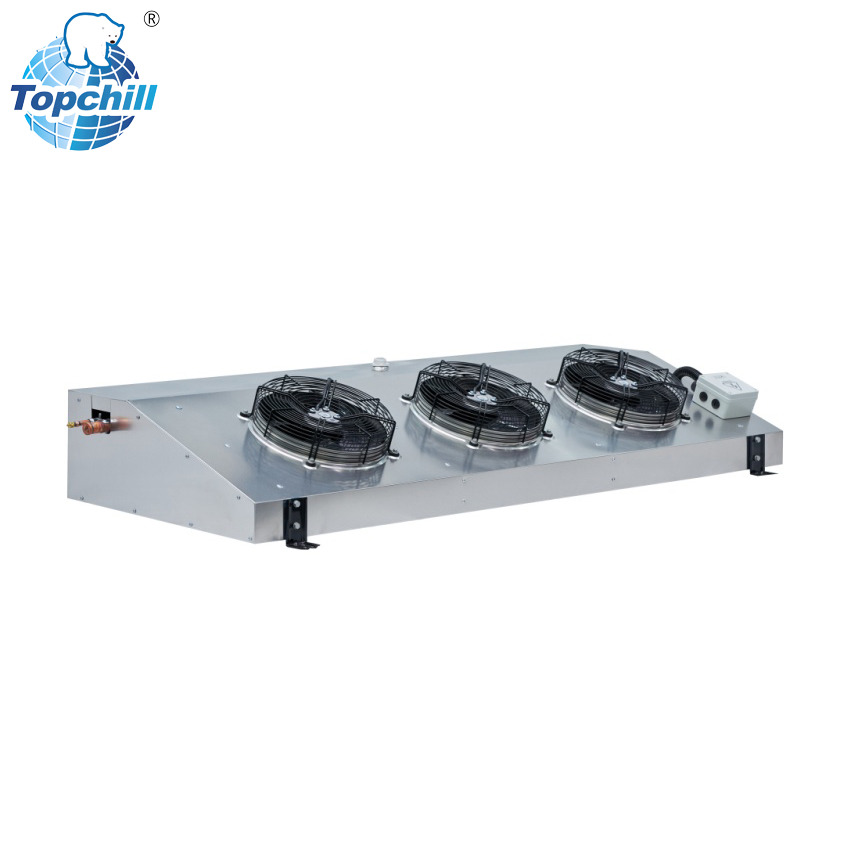
Evaluating a hygienic evaporator begins with metallurgy and coatings. Standard aluminum or galvanized casings are insufficient. Food-grade units require 304 or 316 stainless steel casings to withstand harsh sanitation regimens. The coils themselves demand protection; epoxy-coated, e-coated, or hydrophobic-coated aluminum or copper fins are necessary to resist corrosive cleaning agents, sanitizers, and the natural organic acids released by stored food products. When you walk into a facility that has used standard coils for a few years, you will see the fins literally crumbling away into the drain pan.
Structural design dictates cleanability. Engineering features must align with facility SSOPs to ensure maintenance teams can sanitize the unit effectively without excessive labor or specialized tools. If a sanitation crew needs a socket set and thirty minutes just to open the unit, they will likely skip cleaning the internal components.
Critical structural features include:
Motor and component ingress protection is equally critical. Fan motors must carry IP55, IP66, or IP69K ratings. An IP69K rating ensures the motor can withstand direct, high-pressure, high-temperature washdowns typical of Clean-in-Place (CIP) processes without electrical failure or water ingress. Specifying lower-rated motors guarantees premature failure and maintenance bottlenecks. When a motor fails in a fully loaded cold room, you lose temperature control immediately, putting the entire inventory at risk.
Air distribution strategies must be carefully matched to the stored product. High-velocity, high-CFM airflow is necessary for rapid blast chilling to bring core temperatures down quickly. Conversely, horticultural produce requires low-velocity, high-humidity, and laminar airflow to prevent desiccation, moisture loss, and skin shriveling. Applying blast-chilling airflow to delicate produce results in immediate product degradation and financial loss.
Operational requirements for a medium temperature air cooler focus on maintaining the critical 32°F to 40°F (0°C to 4°C) range. Maintaining tight temperature deltas is essential to preserve food shelf-life and slow microbial growth. Temperature fluctuations within the cold room lead to condensation on the product, which accelerates spoilage.
Calculating required CFM (Cubic Feet per Minute) and air throw distance depends heavily on room dimensions and racking layouts. Consider a typical chamber layout measuring 18m x 16m x 4m used for storing apples. Evaporator positioning, ceiling clearance, and air ducting configurations must be engineered to eliminate thermal dead zones and prevent the short-circuiting of cold air. If the throw distance is insufficient, product at the rear of the room will experience localized warm spots, while product directly in front of the cooler may suffer from chill damage.
To properly configure the air distribution, follow these field-tested steps:
The physics of moisture migration dictate that improper moisture management leads to ceiling condensation. In a food processing environment, this condensation can drip onto exposed food products, introducing airborne pathogens and causing immediate regulatory failures. Effective moisture control requires a balanced system that manages humidity while preventing frost accumulation on the evaporator coils.
Defrost cycles must be tailored for specific food environments. Selecting the wrong method introduces unnecessary heat or fails to clear ice effectively. Ice buildup acts as an insulator, drastically reducing the cooling capacity of the coil and forcing the compressors to run longer.
| Defrost Method | Application & Characteristics |
|---|---|
| Air Defrost | Suitable for rooms kept strictly above 36°F (2°C). Utilizes ambient room air to melt frost. |
| Electric Defrost | Provides precise control but introduces localized heat spikes into the cold room environment. |
| Hot Gas Defrost | Offers high efficiency and speed, significantly reducing the thermal load introduced into the room during cycles. |
| Water Defrost | Uses a spray of water over the coils. Fast, but requires robust drainage and introduces moisture to the room. |
Drainage engineering is a critical component of moisture management. Condensate must be rapidly and completely removed from the cold room environment. This requires insulated, heated drain pans to prevent ice formation at the drain point. Drain lines must be properly trapped, oversized, and sloped to ensure continuous flow and prevent backups that could overflow the pan and contaminate the space below. A common field error is running drain lines without heat trace tape in freezing environments, which inevitably leads to burst pipes and massive ice blocks on the floor.
Installing heavy, stainless-steel hygienic equipment presents structural risks, particularly when retrofitting existing facilities. Ceiling load capacities must be verified, and structural support reinforcements are often necessary. Additionally, existing refrigeration piping and refrigerant compatibility must be assessed to ensure seamless integration without compromising system integrity. You cannot simply hang a 1,500-pound stainless steel unit from a ceiling panel designed for a 500-pound aluminum unit.
Cross-contamination during installation is a severe risk in active food processing facilities. Protocols must be established to ensure that installation, pipe welding, and commissioning processes do not introduce dust, metal shavings, or microbial contaminants into adjacent clean zones. Temporary containment barriers and negative air pressure systems are standard mitigation tactics. All tools and lifts brought into the facility must be sanitized before crossing the threshold.
System balancing is required to prevent mismatched condensing units and evaporators. An unbalanced refrigeration rack leads to severe coil icing, unstable room temperatures, and compressor failure. Engineering teams must ensure the entire system is calibrated for the specific food-grade application. If the suction pressure is set too low, the coil will run too cold, stripping humidity from the air and dehydrating the stored product.
Commissioning and operational validation form the final step. Post-installation protocols must include comprehensive temperature mapping and airflow visualization, such as smoke testing. These validation steps verify performance parameters and satisfy HACCP verification requirements before any food inventory enters the newly commissioned space. You must prove to the auditors that the room holds temperature evenly across all pallet positions.
Selecting a food-grade air cooler is a foundational component of a facility's food safety, regulatory compliance, and risk-mitigation strategy. Standard commercial equipment cannot survive the chemical sanitation and moisture demands of industrial food processing, making purpose-built hygienic units a strict operational requirement.
The critical path for procurement involves verifying material compliance against FDA and USDA standards, selecting an easy-to-clean hygienic design with hinged pans and smooth surfaces, matching airflow patterns to the specific food commodity, and choosing a balanced defrost system. Skipping any of these steps compromises the entire cold storage environment.
To ensure your facility remains compliant and operational, take the following steps:
A: The FDA requires surfaces in food zones to be smooth, non-absorbent, easily cleanable, and non-toxic. Food-grade coolers utilize high-grade stainless steel and specialized coatings that resist corrosion from constant moisture and harsh chemical sanitation protocols.
A: Standard commercial evaporators harbor bacteria in hidden joints, seams, and fan assemblies. Hygienic models feature sloped drain pans, tool-less access, and continuous welds to prevent the buildup of dangerous microbes like Listeria monocytogenes.
A: It is designed to maintain cold storage environments typically between 32°F and 40°F (0°C to 4°C). This is the critical temperature range required for fresh produce, dairy, and meat processing to retard bacterial growth and maintain product safety.
A: Improper, high-velocity air can cause severe dehydration, weight loss, and skin shriveling in fresh produce. Specialized low-velocity, high-humidity, and balanced-throw cooling systems are required to maintain product quality and yield.
A: Using standard coolers introduces severe risks, including SQF or BRCGS audit failures, rapid equipment degradation from chemical washdowns, and a significantly higher potential for localized warm spots and foodborne illness outbreaks.
A: The best materials include 304 or 316 stainless steel for the external housings and epoxy-coated or e-coated aluminum or copper for the internal coils. These ensure maximum longevity, chemical resistance, and strict regulatory compliance.
A: Features like hinged drain pans and easily accessible fan assemblies allow sanitation teams to perform, verify, and document effective cleaning procedures. This directly satisfies the strict equipment-design and sanitation verification requirements of major safety audits.